Global Digital Construction Market Size, Share & Industry Analysis, By Technology, By Solution Type, By Construction Lifecycle, By Application, By Construction Type, By End User, By Deployment, By Region, Forecast 2026–2033
Market Overview
The Global Digital Construction Market represents the adoption of digital technologies, software platforms, connected systems, automation, and data-driven solutions across the construction lifecycle.
Digital construction is transforming traditional construction workflows by enabling organizations to improve project planning, design coordination, site monitoring, workforce management, procurement, safety, quality control, cost management, and asset operations.
The market includes a broad technology ecosystem covering BIM, AI and machine learning, IoT, digital twins, cloud computing, augmented and virtual reality, drones, robotics, 3D printing, geospatial technologies, computer vision, 5G, edge computing, blockchain, and digital construction platforms.
The transition toward connected construction is being supported by increasing project complexity, skilled-labor shortages, infrastructure investment, smart-city development, sustainability objectives, and demand for real-time project information.
BIM remains a foundational technology within digital construction. Current industry research estimates the global BIM market at approximately USD 9.7 billion in 2026 and USD 23.7 billion by 2033, highlighting the scale of BIM adoption within the wider digital construction ecosystem.
Market Size & Growth Outlook
The Global Digital Construction Market is estimated at approximately USD 14.5 Billion in 2025 and is projected to reach approximately USD 38.5 Billion by 2033, expanding at a CAGR of approximately 13.0% during 2026–2033.
The market is estimated to reach approximately USD 16.4 Billion in 2026, marking the beginning of the forecast period.
Growth is being supported by increasing adoption of BIM, cloud-based construction platforms, AI-powered analytics, IoT-connected equipment, digital twins, drones, computer vision, robotics, and advanced project-management technologies.
Current research on digital construction platforms estimates the market at USD 12.8 billion in 2024 and projects it to reach USD 38.5 billion by 2033 at a CAGR of approximately 13.2%, providing a useful external benchmark for Lumera's broader market model.
The broader digital construction ecosystem is also supported by rapid growth in individual technology categories. For example, BIM is forecast to reach USD 23.7 billion by 2033, while AI in construction is projected to grow from approximately USD 6.2 billion in 2026 to USD 32 billion by 2033
Quick Market Figures
- Base Year: 2025
- Forecast Period: 2026–2033
- Base Year Market Size: USD 14.5 Billion
- Forecast Market Size: USD 38.5 Billion
- CAGR: 13.0%
- 2026 Estimated Market Size: USD 16.4 Billion
- Leading Segment: Building Information Modeling (BIM)
- Leading Solution Type: Software
- Fastest-Growing Technology: Artificial Intelligence & Machine Learning
- Leading Region: North America
- Fastest-Growing Region: Asia Pacific
Leading Segment
By Technology – Building Information Modeling (BIM): Building Information Modeling represents a leading technology segment within the Digital Construction Market. BIM enables construction stakeholders to create, manage, coordinate, and share digital representations of buildings and infrastructure throughout the project lifecycle.
BIM supports architectural and engineering design, clash detection, coordination, cost estimation, scheduling, documentation, construction planning, and asset management.
Its role is also expanding as BIM becomes increasingly connected with cloud collaboration, digital twins, AI, IoT, and common data environments.
By Lifecycle – Pre-Construction and Design & Engineering: Pre-construction and design activities represent important areas of digital technology adoption because early-stage decisions have a significant impact on project cost, schedule, constructability, and risk.
Digital tools support feasibility analysis, site analysis, conceptual design, cost estimation, project planning, BIM modeling, clash detection, simulation, and design optimization.
By Application – Project Management: Project management is a major application area for digital construction technologies. Cloud platforms, scheduling systems, cost-management tools, document management, collaboration platforms, and real-time analytics help project teams coordinate activities and improve project visibility.
Market Drivers
Increasing Construction Project Complexity: Large-scale infrastructure, industrial, commercial, and specialized construction projects require greater coordination among multiple stakeholders, increasing demand for integrated digital workflows.
Growing Labor Shortages: Skilled-labor shortages are encouraging construction companies to adopt automation, AI, robotics, computer vision, and digital workforce-management technologies to improve productivity.
Rising Adoption of BIM: BIM is becoming increasingly important for design coordination, project planning, collaboration, cost management, and lifecycle asset management.
Increasing Cloud Adoption: Cloud-based construction platforms enable geographically distributed teams to access project information, documents, models, schedules, and workflows in real time.
Growth of Artificial Intelligence: AI is increasingly being applied to construction estimation, scheduling, risk prediction, design optimization, document processing, safety monitoring, and project analytics.
Increasing Demand for Real-Time Project Visibility: Construction stakeholders increasingly require real-time information on project progress, workforce, equipment, materials, costs, and risks.
Growth of Smart Cities: Smart-city development is increasing demand for digitally integrated buildings and infrastructure supported by BIM, IoT, digital twins, geospatial technologies, and connected systems.
Increasing Sustainability Requirements: Digital technologies can support carbon tracking, energy optimization, material optimization, waste reduction, and ESG reporting.
Market Restraints
High Initial Technology Investment: Advanced digital construction platforms, sensors, robotics, drones, BIM systems, and digital twin infrastructure can require substantial initial investment.
Digital Skills Shortage: Limited availability of skilled professionals capable of implementing and operating advanced digital construction technologies can slow adoption.
Resistance to Technology Adoption: Construction organizations with established manual workflows may face organizational and cultural barriers when transitioning toward digital processes.
Fragmented Construction Ecosystem: Construction projects involve numerous contractors, subcontractors, suppliers, consultants, owners, and technology platforms, creating challenges for digital coordination.
Data Interoperability Challenges: Different software platforms and systems may use different data structures and standards, creating difficulties in integrating project information.
Cybersecurity Risks: Increasing connectivity across construction platforms, equipment, IoT devices, and cloud systems increases exposure to cybersecurity threats.
Legacy System Integration: Existing construction organizations may need to integrate new digital platforms with older software, hardware, and workflows.
Market Opportunities
Generative AI in Construction: Generative AI can support design generation, document processing, cost estimation, scheduling, project analysis, and decision support.
AI-Powered Construction Workflows: AI can increasingly automate repetitive processes and provide predictive insights across cost, scheduling, safety, quality, and project management.
Autonomous Construction: Autonomous and semi-autonomous equipment creates opportunities to improve productivity, precision, and safety on construction sites.
Digital Twins: Digital twins provide opportunities to connect design, construction, commissioning, and operational asset data within an integrated digital environment.
Connected Jobsites: IoT sensors, connected equipment, cameras, drones, and edge computing can create real-time visibility across construction sites.
Construction Robotics: Robotics and automation offer opportunities for repetitive activities such as bricklaying, layout, welding, material handling, and other construction tasks.
Computer Vision: Computer vision can support safety monitoring, PPE detection, progress tracking, automated inspection, and defect detection.
Smart Infrastructure: Digital construction technologies can support the development and operation of increasingly connected buildings, transportation networks, utilities, and other infrastructure.
Digital Asset Management: Digital information generated during construction can increasingly be transferred into operations and maintenance, creating long-term opportunities for predictive maintenance and asset performance management.
Regional Insights
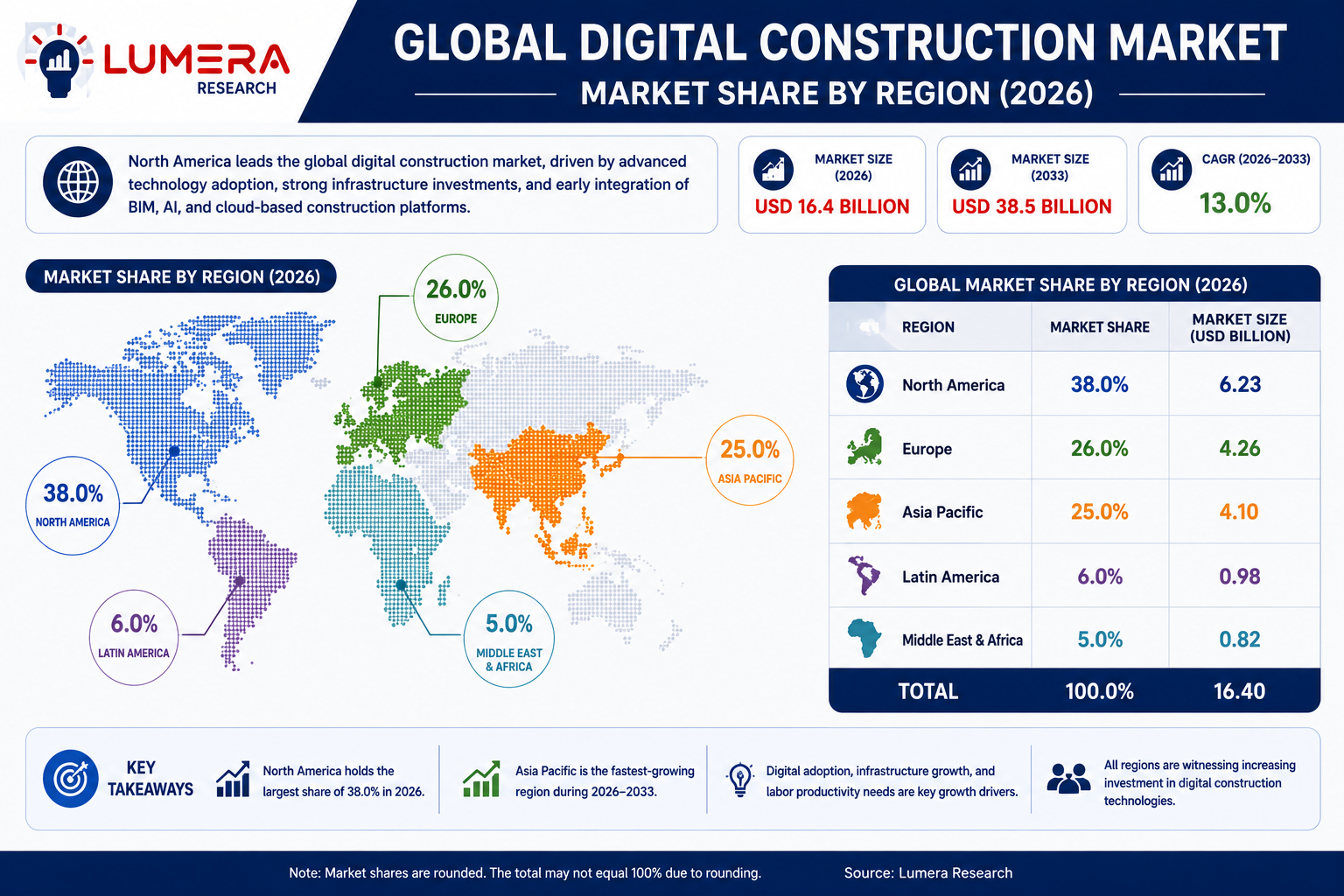
North America: North America represents the leading regional market, supported by advanced adoption of BIM, cloud construction platforms, project-management software, AI, IoT, and connected construction technologies. Current BIM research identifies North America as the largest regional market, accounting for approximately 46.5% of global BIM revenue in 2024.
Estimated 2026 Regional Share: 38%
Europe: Europe represents a mature digital construction market supported by BIM adoption, sustainability initiatives, digital construction regulations, infrastructure modernization, and strong engineering and construction technology capabilities.
Estimated 2026 Regional Share: 26%
Asia Pacific: Asia Pacific is expected to be the fastest-growing regional market, supported by rapid urbanization, infrastructure development, smart-city investment, industrial construction, and increasing digital adoption. Recent digital construction research also identifies Asia Pacific as the fastest-growing region.
Estimated 2026 Regional Share: 25%
Latin America: Increasing infrastructure investment, urbanization, construction modernization, and growing adoption of cloud-based project-management tools are supporting regional digital construction adoption.
Estimated 2026 Regional Share: 6%
Middle East & Africa: Smart-city developments, mega infrastructure projects, tourism developments, transportation investments, and large-scale urban projects are creating demand for BIM, digital twins, project-management platforms, and connected construction technologies.
Estimated 2026 Regional Share: 5%
Key Companies
- Autodesk
- Bentley Systems
- Trimble
- Procore Technologies
- Oracle
- Hexagon
- Nemetschek
- Dassault Systèmes
- Siemens
- Schneider Electric
- Microsoft
- SAP
- Caterpillar
- Komatsu
- Hilti
- Leica Geosystems
- Topcon Positioning Systems
- DroneDeploy
- OpenSpace
- Bluebeam
Key Companies: The competitive landscape includes construction software providers, BIM and engineering technology companies, geospatial technology providers, construction equipment manufacturers, cloud technology companies, and specialized digital construction platforms. The competitive environment is shaped by product development, technology integration, cloud adoption, AI capabilities, strategic partnerships, and expansion into connected construction workflows.
Customization & Consulting Support
Customization & Consulting Support: Customized research and consulting services are available to support specific business intelligence, technology assessment, competitive strategy, investment planning, and digital transformation requirements within the construction industry.
Available services include:
- Country-level digital construction market analysis
- Regional market sizing
- Competitive benchmarking
- Digital construction technology landscape analysis
- BIM market analysis
- AI in construction analysis
- Digital twin assessment
- Construction software benchmarking
- Connected jobsite analysis
- Construction technology adoption analysis
- Construction project pipeline analysis
- Supply chain mapping
- Pricing analysis
- Digital maturity assessment
- Technology adoption benchmarking
- Go-to-market strategy advisory
- Custom market sizing and forecasting
- Investment opportunity assessment
Data Sources
The Global Digital Construction Market report is developed using a combination of Primary Research and Secondary Research methodologies to provide comprehensive market intelligence.
Primary Research:
- Interviews with construction company executives
- Discussions with general and specialty contractors
- Consultations with EPC companies
- Interviews with construction technology providers
- Discussions with BIM and digital twin specialists
- Consultations with architects and engineering firms
- Interviews with construction equipment manufacturers
- Discussions with infrastructure developers and owners
- Consultations with construction software providers
Secondary Research:
- Company annual reports and financial filings
- Construction industry association publications
- Government infrastructure reports
- BIM and digital construction standards
- Regulatory databases
- Construction technology publications
- Industry journals and trade publications
- Technology provider reports
- Company investor presentations
- Product documentation
- Construction project databases
- Industry research publications
- Company press releases
- Market intelligence databases
Who This Report Is For
- General Contractors
- Specialty Contractors
- EPC Companies
- Construction Technology Providers
- BIM Software Providers
- Construction Software Companies
- Engineering Firms
- Architecture Firms
- Real Estate Developers
- Infrastructure Developers
- Construction Equipment Manufacturers
- Building Owners
- Facility Owners
- Government Agencies
- Infrastructure Authorities
- Technology Investors
- Private Equity Firms
- Venture Capital Firms
- Strategy Consultants
- Industry Stakeholders
Why Buy This Report
Comprehensive Market Intelligence: Gain detailed insights into the size, structure, technology landscape, growth opportunities, competitive environment, and future outlook of the Global Digital Construction Market.
Detailed Technology Analysis: Understand adoption and development across BIM, AI, IoT, digital twins, cloud computing, drones, robotics, computer vision, geospatial technologies, AR/VR, 3D printing, and connected construction.
Lifecycle-Based Analysis: Assess digital technology adoption across pre-construction, design and engineering, construction, commissioning, and operations and maintenance.
Market Segmentation: Identify high-growth opportunities across technology, solution type, application, construction type, end user, company size, deployment, business model, digital maturity, and regional markets.
Competitive Benchmarking: Evaluate leading construction technology and software companies based on product portfolios, technology capabilities, geographic presence, strategic developments, partnerships, and competitive positioning.
Emerging Technology Intelligence: Assess the impact of generative AI, AI agents, autonomous construction equipment, digital twins, computer vision, robotics, predictive analytics, and connected jobsites.
Regional & Country Insights: Understand digital construction adoption, technology maturity, infrastructure development, and emerging opportunities across major global markets.
Strategic Decision Support: Identify technology investment opportunities, market-entry opportunities, partnership possibilities, and emerging business models within the digital construction ecosystem.
Explore More Reports
Explore additional market intelligence reports from Lumera Research Report Store: https://lumeraresearch.com/market-research-reports/
Global Construction Market Size, Share & Industry Analysis, By Construction Type, By Project Type, By End Use, By Region, Forecast 2026–2035