Global Construction Market Size, Share & Industry Analysis, By Construction Type, By Project Type, By End Use, By Region, Forecast 2026–2035
Overview: The Global Construction Market represents a broad and highly diversified industry encompassing the development, construction, renovation, and maintenance of residential, commercial, industrial, institutional, and infrastructure assets. Construction activity is closely linked to economic development, population growth, urbanization, industrial investment, government infrastructure programs, and private-sector capital expenditure.
The global construction industry is undergoing a structural transformation as contractors, developers, engineering firms, and infrastructure operators increasingly adopt digital technologies and modern construction methods. Building Information Modeling (BIM), digital twins, modular and prefabricated construction, construction robotics, AI-enabled project management, and advanced materials are increasingly being incorporated to improve project efficiency, reduce delays, and address labor shortages.
Infrastructure development remains an important source of demand, particularly in emerging markets. Transportation networks, utilities, energy systems, telecommunications infrastructure, water infrastructure, and urban development projects are expected to support long-term construction activity.
Market Size & Growth Outlook
Market Size & Growth Outlook: The Global Construction Market is projected to grow from approximately USD 14.45 Trillion in 2025 to nearly USD 23.99 Trillion by 2035, registering a CAGR of approximately 5.2% during 2026–2035. Growth is expected to be supported by infrastructure modernization, housing requirements, urban development, industrial investment, energy-transition projects, and increasing construction activity across emerging economies.
The near-term construction outlook remains mixed across markets. Oxford Economics expects global construction activity to recover in 2026 following a contraction in 2025, with civil engineering showing stronger growth than residential and non-residential building activity in its latest published outlook.
Longer-term demand is expected to remain supported by major infrastructure requirements and the expansion of construction activity in emerging Asian markets. Oxford Economics has identified China, the United States, and India as major global construction markets, while several Southeast Asian economies are expected to record comparatively strong long-term growth.
Quick Market Figures
- Base Year: 2025
- Forecast Period: 2026–2035
- Base Year Market Size: USD 14.45 Trillion
- Forecast Market Size: USD 23.99 Trillion
- CAGR: 5.2%
- Leading Segment: Building Construction
- Fastest-Growing Region: Asia Pacific
The market-size and CAGR figures above are aligned with a current 2026–2035 construction-market forecast.
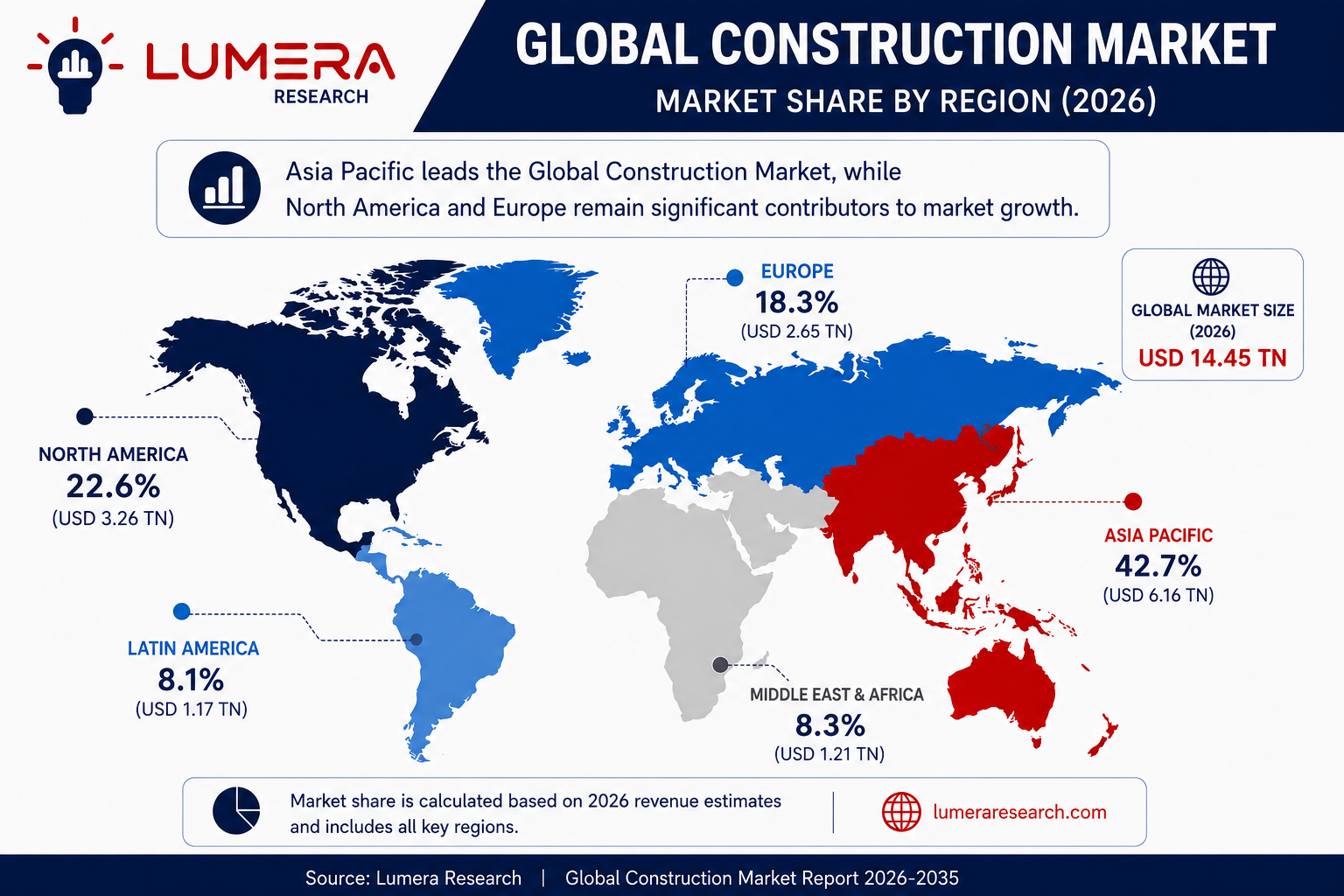
Leading Segment
By Construction Type – Building Construction: Building construction represents a leading segment of the global construction industry due to continuing demand for residential properties, commercial buildings, industrial facilities, institutional infrastructure, and mixed-use developments. Housing requirements, urbanization, population growth, replacement of aging buildings, and commercial development continue to generate substantial construction activity.
Residential Construction: Residential construction remains a major component of global building activity, supported by housing shortages, urban population growth, household formation, and government housing programs. However, residential construction performance varies considerably by country based on interest rates, affordability, mortgage availability, and local real estate conditions.
Market Drivers
Rapid Urbanization and Population Growth: Continued urbanization is increasing demand for housing, commercial facilities, transportation infrastructure, utilities, and public services. Emerging economies are expected to remain important sources of construction demand as cities expand and populations become increasingly urban.
Infrastructure Modernization: Governments are investing in transportation, energy, water, telecommunications, and public infrastructure to improve economic competitiveness and accommodate population growth.
Housing Demand: Housing shortages and rising household formation in several economies are supporting residential construction activity. Housing demand is particularly important in rapidly urbanizing markets across Asia and other emerging regions.
Industrial Expansion: New manufacturing facilities, logistics centers, warehouses, semiconductor plants, energy projects, and industrial parks are generating construction opportunities.
Energy Transition Investments: Renewable energy generation, electricity transmission, grid modernization, battery facilities, and related infrastructure are creating new construction requirements.
Data Center Development: The rapid expansion of cloud computing and artificial intelligence is increasing demand for data centers and associated power and infrastructure projects. Deloitte identifies AI-driven data center construction and related energy infrastructure as notable areas of growth within the engineering and construction industry.
Digitalization of Construction: BIM, digital twins, AI, robotics, project management platforms, and connected construction technologies are improving productivity and enabling more efficient project delivery.
Market Restraints
High Construction Costs: Rising costs of labor, materials, equipment, financing, and land can reduce project feasibility and place pressure on contractor margins.
Labor Shortages: The construction industry continues to face shortages of skilled workers, engineers, project managers, and specialized technical professionals in many markets.
Interest Rate and Financing Risks: Higher borrowing costs can delay residential, commercial, and private infrastructure projects by increasing project financing expenses.
Supply Chain Disruptions: Shortages or price volatility involving steel, cement, timber, electrical equipment, machinery, and other construction materials can affect project schedules and profitability.
Regulatory Complexity: Construction projects often require multiple permits, environmental approvals, safety certifications, zoning approvals, and compliance procedures, potentially increasing project timelines.
Project Delays and Cost Overruns: Complex projects can face delays caused by design changes, labor constraints, material shortages, weather conditions, permitting issues, and contractor coordination challenges.
Recent industry outlooks continue to identify inflation, elevated interest rates, tariffs, labor shortages, supply-chain disruption, and material-price volatility as important challenges for construction companies.
Market Opportunities
Modular and Prefabricated Construction: Off-site manufacturing and modular construction can reduce construction timelines, improve quality control, and address labor constraints. Digitalization and skills shortages are supporting increased interest in industrialized construction approaches.
Smart Construction: AI, IoT, drones, digital twins, robotics, and connected project-management platforms are creating opportunities to improve productivity, safety, cost management, and project visibility.
Green Construction: Growing sustainability requirements are increasing demand for energy-efficient buildings, low-carbon materials, renewable energy integration, and environmentally responsible construction methods.
Data Center Construction: The rapid expansion of AI and cloud infrastructure is creating significant opportunities for specialized data center construction, electrical infrastructure, cooling systems, and power projects.
Infrastructure Development in Emerging Markets: Urbanization and economic development across Asia Pacific, Africa, Latin America, and the Middle East are generating opportunities in transportation, housing, utilities, and public infrastructure.
Renovation and Building Retrofit: Aging infrastructure and increasingly stringent energy-efficiency requirements are creating opportunities for renovation, refurbishment, and building modernization.
Construction Robotics and Automation: Increasing labor costs and workforce shortages are encouraging construction companies to adopt robotics, autonomous equipment, automated surveying, and AI-assisted project management.
Regional Insights
North America: North America represents a major construction market supported by residential development, infrastructure modernization, industrial facilities, data centers, energy infrastructure, and commercial construction. Demand is also being influenced by investments in domestic manufacturing capacity and infrastructure modernization.
Europe: Europe is experiencing construction demand from infrastructure modernization, energy transition projects, building renovation, defense-related infrastructure, sustainability requirements, and urban redevelopment. Regulation and environmental targets are also accelerating demand for energy-efficient construction and retrofit projects.
Asia Pacific: Asia Pacific is expected to remain the largest and one of the fastest-growing construction regions due to urbanization, population growth, infrastructure investment, industrialization, and expanding construction activity across China, India, Southeast Asia, and other emerging economies. Oxford Economics identifies emerging Asian markets, including Indonesia, the Philippines, and Vietnam, among the faster-growing construction markets over the long term.
Latin America: Construction activity across Latin America is supported by urban development, housing requirements, transportation infrastructure, industrial investment, and energy projects. Increasing private investment and public infrastructure programs are expected to support regional opportunities.
Middle East & Africa: The Middle East is witnessing major construction investment associated with urban development, tourism, transportation, energy diversification, and large-scale development programs. Africa offers long-term construction opportunities driven by urbanization, population growth, housing requirements, transportation infrastructure, and utilities development.
Key Companies
- China State Construction Engineering Corporation (CSCEC)
- VINCI
- Bouygues
- ACS Group
- Bechtel Corporation
- Larsen & Toubro (L&T)
- STRABAG
- Skanska
- Fluor Corporation
- Kiewit Corporation
- Turner Construction Company
- Hochtief
- Hyundai Engineering & Construction
- Kajima Corporation
- Samsung C&T Corporation
Data Sources
The Global Construction Market report is developed using a combination of Primary Research and Secondary Research methodologies to provide comprehensive and reliable market intelligence.
Primary Research
- Interviews with construction company executives
- Discussions with contractors and EPC companies
- Consultations with property developers
- Interviews with infrastructure project operators
- Discussions with architects and engineering consultants
- Consultations with construction technology providers
- Interviews with government and infrastructure stakeholders
Secondary Research
- Company annual reports and financial filings
- Government infrastructure investment reports
- Construction industry association publications
- Building and construction statistics
- Infrastructure development databases
- Industry journals and trade publications
- Construction project databases
- Regulatory and policy documents
- Investor presentations
- Company press releases
- Industry research publications
- Market intelligence databases
Who This Report Is For
- Construction Companies
- General Contractors
- Engineering, Procurement & Construction (EPC) Companies
- Infrastructure Developers
- Real Estate Developers
- Building Material Manufacturers
- Construction Equipment Manufacturers
- Architecture & Engineering Firms
- Construction Technology Providers
- Government Agencies
- Infrastructure Authorities
- Private Equity Firms
- Venture Capital Firms
- Institutional Investors
- Banks & Financial Institutions
- Strategy Consultants
- Industry Stakeholders
Why Buy This Report
Comprehensive Market Intelligence: Gain detailed insights into the current structure, competitive landscape, growth prospects, and long-term outlook of the Global Construction Market.
Reliable Market Forecasts: Access market forecasts covering 2026–2035 across major construction types, project categories, end-use industries, and geographic markets.
Detailed Segmentation Analysis: Identify high-growth opportunities across residential, commercial, industrial, institutional, transportation, energy, utilities, and other infrastructure segments.
Regional Market Intelligence: Understand construction activity, infrastructure investment, urbanization trends, and emerging opportunities across North America, Europe, Asia Pacific, Latin America, and the Middle East & Africa.
Competitive Benchmarking: Evaluate leading construction companies based on geographic presence, project portfolios, strategic initiatives, technology adoption, and competitive positioning.
Technology & Innovation Insights: Assess the impact of BIM, AI, robotics, digital twins, modular construction, 3D printing, drones, and other technologies transforming the construction industry.
Strategic Decision Support: Identify emerging investment opportunities, market trends, construction demand drivers, and regional expansion opportunities to support strategic planning.
Customization & Consulting Support
Customization & Consulting Support: Customized research and consulting services are available to support specific business intelligence, investment planning, market entry, competitive strategy, and construction industry requirements.
Available services include:
- Country-level construction market analysis
- Regional construction market analysis
- Competitive benchmarking
- Construction project pipeline analysis
- Infrastructure investment analysis
- Contractor and developer profiling
- Construction technology landscape analysis
- Supply chain mapping
- Pricing and cost analysis
- Market entry strategy
- Go-to-market strategy advisory
- Custom market sizing and forecasting
- Investment opportunity assessment
Explore More Reports
Explore additional market intelligence reports from Lumera Research covering: https://lumeraresearch.com/market-research-reports/