Overview:
The global Trade Management Software market is expected to grow steadily from 2026 to 2036, driven by increasing complexity in global trade operations, rising regulatory and compliance requirements, and the need for real-time visibility across supply chains. The market is estimated to expand from USD ~2.9–3.2 billion in 2026 to approximately USD ~8.5–9.8 billion by 2036, registering a CAGR of ~11.5–13.0% during the forecast period.
Trade management software enables organizations to automate and optimize international trade processes, including customs compliance, tariff and duty management, trade documentation, export controls, and global logistics coordination. As enterprises expand cross-border operations and governments enforce stricter trade regulations, demand for integrated and compliant trade management solutions continues to rise.
Leading Segment:
Cloud-Based Trade Management Software
Cloud-based trade management software represents the leading segment in the global market. This segment dominates due to its scalability, faster deployment, and ability to support real-time trade compliance across multiple geographies.
Cloud-based solutions enable enterprises to manage frequently changing trade regulations, tariffs, and customs requirements without heavy upfront infrastructure investments. Their seamless integration with ERP, supply chain, and logistics platforms allows organizations to improve visibility, reduce compliance risks, and enhance operational efficiency. The growing preference for SaaS-based enterprise applications has positioned cloud deployment as the primary revenue-generating segment.
Market Drivers:
- Growing complexity of global trade regulations and customs compliance requirements.
- Expansion of cross-border e-commerce and international supply chains.
- Increasing need for automation to reduce trade-related errors and penalties.
- Integration of trade management with ERP, supply chain, and logistics platforms.
- Rising adoption of data analytics for trade optimization and risk management.
Market Restraints:
- High implementation and customization costs for large enterprises.
- Complexity in integrating with legacy IT and ERP systems.
- Limited awareness of advanced trade compliance solutions in emerging markets.
- Data security and confidentiality concerns related to trade information.
Regional Dynamics:
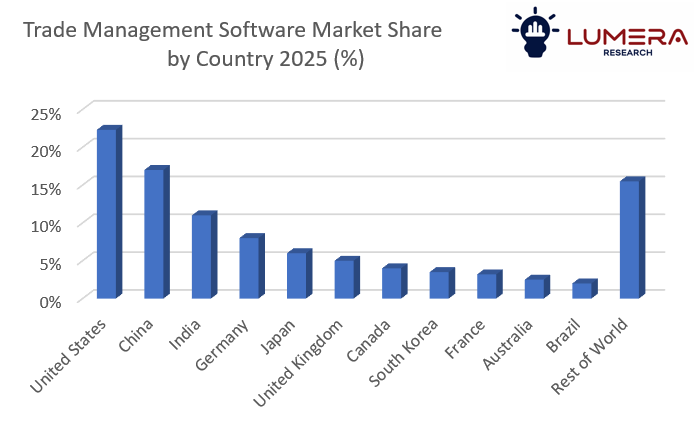
- North America – Largest market driven by advanced enterprise software adoption, strong regulatory enforcement, and high demand from multinational corporations.
- Europe – Significant growth supported by complex cross-border trade within the region and stringent customs and compliance frameworks.
- Asia Pacific – Fastest-growing region due to expanding international trade volumes, manufacturing exports, and digital transformation of supply chain operations.
- Latin America – Moderate growth led by trade facilitation initiatives and modernization of customs processes.
- Middle East & Africa – Emerging growth supported by increasing trade activity, logistics hub development, and digital trade infrastructure investments.
Quick Market Figures:
- 2026 Market Size (Estimated): ~USD 2.9–3.2 Billion
- 2036 Market Size (Projected): ~USD 8.5–9.8 Billion
- CAGR (2026–2036): ~11.5–13.0%
- Leading Segment: Cloud-Based Trade Management Software
- Fastest-Growing Region: Asia Pacific
Key Companies (Representative List):
- SAP SE
• Oracle Corporation
• Descartes Systems Group
• BluJay Solutions (E2open)
• Infor
• Amber Road (E2open)
• Integration Point
• MIC Customs Solutions
• Livingston International
• Thomson Reuters (ONESOURCE)
• Aptean
• QAD Inc.
• WiseTech Global
• Kewill
• Cleo Communications