Thermal Inkjet Printers Market Forecast 2026–2036
Thermal Inkjet Printers Market value is USD 2.8 billion in 2025, nearly doubling to USD 4.2 billion by 2035 (a steady 4.1% CAGR). Demand will be dominated by industrial/coder applications in food and beverage, pharmacy and packaging industries. These industries have very strict labelling and traceability requirements. At the same time, TIJ desktop and office segments continue to service document and photo printing in small businesses and consumer markets.
Leading segments in Thermal Inkjet Printers:
Food and beverage sector, along with coding and marking applications is the largest single application (42% of TIJ market in 2025).
Desktop and office TIJ printers account for a large share of unit shipments (51% of unit type share in 2025).
Large-format and high-speed industrial Thermal Inkjet Printers are rapidly expanding within packaging lines.
Drivers
- Labelling and traceability food, pharma and cosmetics serialization drives stronger TIJ coding and marking responsiveness.
- Sustainability and operational efficiency are linked. Low solvent TIJ coders are renowned for less maintenance and waste compared to other technologies.
- E-commerce & Packaging Growth — higher parcel volumes and customized packaging require on-demand, flexible printing.
- Improved Print Resolution & Integration — advances in thermal inkjet heads, inks and integration with Industry 4.0 / IIoT for line-level data enable broader adoption.
Restraints
- Competition from Other Technologies: continuous inkjet (CIJ), laser marking and thermal transfer remain preferred for some high-speed or solvent-resistant coding needs.
- Consumables & Running Costs: ink and head replacement can be significant for certain high-volume deployments.
- Integration Complexity: retrofitting legacy production lines with TIJ coders requires customization and system engineering.
- Fragmented End-User Spend: varied needs across sectors (pharma vs. e-commerce vs. textile) complicate standardized product adoption.
Thermal Inkjet Printers: Regional Dynamics
Americas (North America lead):
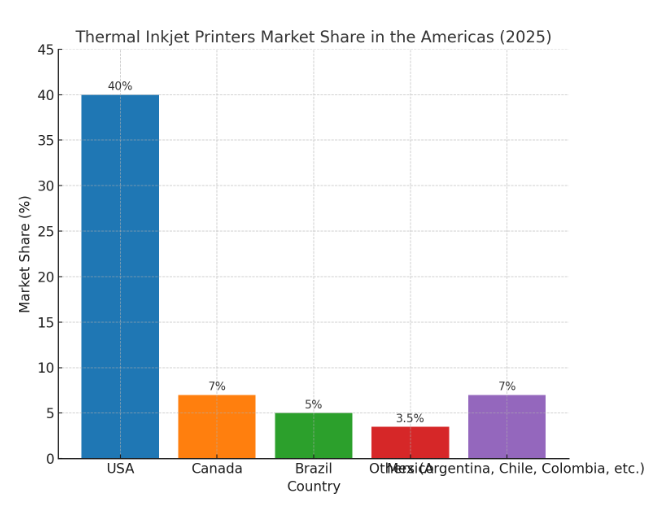
North America, particularly the United States, dominates the Thermal Inkjet Printers market, accounting for over ~35% of the market, driven by advanced manufacturing, strict regulatory frameworks and strong food & beverage manufacturing bases. Canada and Mexico show steady demand tied to packaging modernization.
Europe:
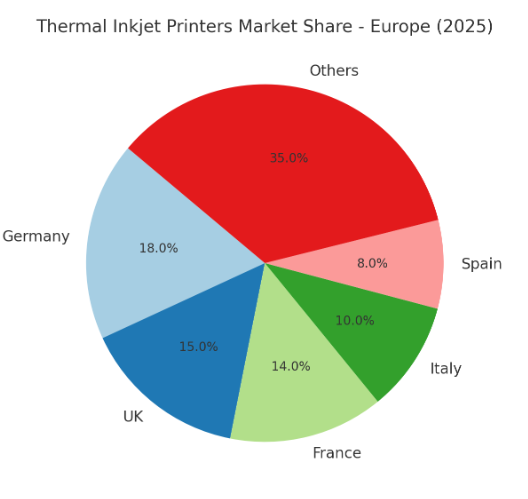
Europe is a strong market for TIJ in packaging and pharmaceutical serialization. EU regulatory focus on traceability and cross-border supply chains encourages adoption of modular TIJ systems that interoperate with MES/ERP systems.
APAC:
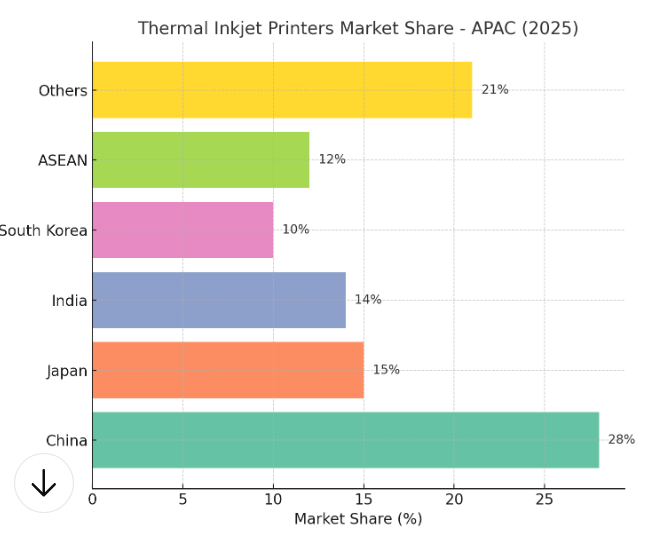
Asia-Pacific is the fastest-growing region, driven by expanding food & beverage, consumer products, and e-commerce packaging capacity in China, India, Southeast Asia and South Korea. Investment in automation and growing manufacturing hubs accelerate TIJ uptake.
Key Players: Thermal Inkjet Printers
- Videojet Technologies Inc.
- HP Inc.
- Canon Inc.
- Seiko Epson Corporation
- Domino Printing Sciences
- Markem-Imaje
- Willett (under Videojet group)
- Fujifilm
- Konica Minolta
- Ricoh
- Toshiba
- Lexmark
- Brother Industries Ltd.
- Zebra Technologies
- Hitachi Industrial Equipment
- Kyocera
- Fujifilm Dimatix
- Spectra
- Afinia
- Regional TIJ system integrators & OEM partners
Quick Market Figures
- 2025 market size: USD 2.8 Billion
- 2035 market size (projected): USD 4.2 Billion
- CAGR (2025–2035): 4.1%
- Largest application (2025): Food & Beverage (~42% share)
- Regional leader: North America (~35%+ of market)

Report Coverage & Deliverables
- Market Trends And Dynamics
- Competitve Benchmarking
- Historical data and forecasts
- Value/Volume analysis
- Company revenue shares and key strategies
- Regional opportunities
- By Product Type
- Desktop / Office Thermal Inkjet Printers
- Home office printers
- Small business printers
- Photo printing systems
- Industrial TIJ Coders & Marking Systems
- Packaging line printers
- High-speed coders
- Large-format industrial printers
- Specialized TIJ Printers
- Medical & laboratory equipment printers
- Ticketing & label printers
- Portable handheld TIJ coders
- By Application
- Food & Beverage (date coding, batch printing, ingredient labeling)
- Pharmaceutical & Healthcare (serialization, regulatory labeling)
- Cosmetics & Personal Care (branding, batch info)
- Consumer Electronics (component marking)
- E-commerce & Logistics (on-demand packaging labels, barcodes)
- Industrial & Manufacturing (parts identification, traceability)
- Commercial & Office Printing (documents, brochures)
- By Ink Type
- Dye-based inks
- Pigment-based inks
- Solvent-based inks
- UV-curable inks
- Specialty inks (security, edible inks for food marking)
- By Connectivity / Integration Level
- Standalone desktop printers
- Networked office printers
- Inline industrial printers (integrated with conveyor systems)
- IoT-enabled / Industry 4.0 connected printers
- By End-User
- Enterprises & Corporates
- SMEs & Small Businesses
- Industrial Packaging Companies
- Print Shops & Commercial Printers
- Government & Institutions
- By Region
- Americas
- USA
- Canada
- Brazil
- Mexico
- Others (Argentina, Chile, Colombia)
- Europe
- Germany
- UK
- France
- Italy
- Spain
- Rest of Europe
- APAC
- China
- Japan
- India
- South Korea
- ASEAN
- Rest of APAC
- Middle East & Africa
- GCC Countries
- South Africa
- Rest of MEA
1. Executive Summary
- Market Overview
- Key Findings
- Strategic Insights
- Analyst Recommendations
2. Introduction
- Report Scope
- Research Methodology
- Market Definitions & Taxonomy
3. Market Dynamics
- Drivers
- Restraints
- Opportunities
- Trends & Innovations
- Regulatory Landscape
4. Technology Overview
- Working Principle of Thermal Inkjet (TIJ)
- Comparison with Other Inkjet Technologies
- Recent Technological Advancements
5. Market Size & Forecast (2024–2030)
- Global Market Value & Volume
- CAGR Analysis
- Historical Trends & Future Projections
6. Segmentation Analysis
6.1 By Product Type
- Desktop / Office TIJ Printers
- Home Office Printers
- Small Business Printers
- Photo Printing Systems
- Industrial TIJ Coders & Marking Systems
- Packaging Line Printers
- High-Speed Coders
- Large-Format Industrial Printers
- Specialized TIJ Printers
- Medical & Laboratory Equipment Printers
- Ticketing & Label Printers
- Portable Handheld TIJ Coders
6.2 By Application
- Food & Beverage
- Pharmaceutical & Healthcare
- Cosmetics & Personal Care
- Consumer Electronics
- E-commerce & Logistics
- Industrial & Manufacturing
- Commercial & Office Printing
6.3 By Ink Type
- Dye-Based Inks
- Pigment-Based Inks
- Solvent-Based Inks
- UV-Curable Inks
- Specialty Inks (Security, Edible, etc.)
6.4 By Connectivity / Integration Level
- Standalone Desktop Printers
- Networked Office Printers
- Inline Industrial Printers
- IoT-Enabled / Industry 4.0 Connected Printers
6.5 By End-User
- Enterprises & Corporates
- SMEs & Small Businesses
- Industrial Packaging Companies
- Print Shops & Commercial Printers
- Government & Institutions
7. Regional Analysis
7.1 Americas
- USA
- Canada
- Brazil
- Mexico
- Others (Argentina, Chile, Colombia)
7.2 Europe
- Germany
- UK
- France
- Italy
- Spain
- Rest of Europe
7.3 Asia-Pacific (APAC)
- China
- Japan
- India
- South Korea
- ASEAN
- Rest of APAC
7.4 Middle East & Africa (MEA)
- GCC Countries
- South Africa
- Rest of MEA
8. Competitive Landscape
- Market Share Analysis
- Key Players Overview
- Strategic Developments
- Product Portfolio Mapping
- M&A and Partnerships
9. Future Outlook & Strategic Recommendations
- Emerging Opportunities
- Investment Priorities
- Technology Adoption Roadmap
- Sustainability & Eco-Ink Trends
10. Appendix
- Assumptions & Limitations
- Data Sources


