Overview:
The global Submarine Cable Market is expected to witness strong and sustained growth between 2026 and 2036, driven by surging international data traffic, rapid expansion of cloud services, hyperscale data centers, and increasing investments in cross-border digital infrastructure. Submarine cables form the backbone of global internet connectivity, enabling high-capacity, low-latency transmission of data across continents and supporting critical applications including cloud computing, streaming, financial transactions, and international communications.
Growing dependence on digital economies, 5G rollout, and rising demand for resilient and redundant network architectures are encouraging governments, telecom operators, and technology companies to invest in next-generation submarine cable systems with higher fiber counts and advanced optical technologies.
Leading Segment:
By Component – Submarine Cables (Wet Plant)
The submarine cable (wet plant) segment accounts for the largest share of the market and continues to dominate due to its critical role in determining system capacity, durability, and transmission efficiency. High-fiber-count cables with advanced optical amplification technologies are increasingly deployed to meet exponential growth in global data traffic. Rising investments in long-haul and ultra-long-haul cable systems, coupled with growing demand for enhanced redundancy and fault tolerance, reinforce the leadership of this segment over terminal equipment and installation services.
Market Drivers:
- Rapid growth in global internet traffic and cloud-based services.
- Expansion of hyperscale data centers and intercontinental connectivity needs.
- Rising demand for low-latency, high-bandwidth international communication.
- Increasing private investments by technology companies in cable ownership.
- Growing digitalization and cross-border data exchange across industries.
Market Restraints:
- High capital expenditure associated with submarine cable deployment.
- Complex regulatory approvals and maritime compliance requirements.
- Environmental concerns related to seabed disturbance.
- Vulnerability to cable faults caused by fishing activities and natural disasters.
Opportunities:
- Deployment of next-generation high-fiber-count and open cable systems.
- Growing connectivity demand from emerging markets and island nations.
- Integration of advanced monitoring and fault-detection technologies.
- Increasing use of submarine cables to support offshore energy infrastructure.
Regional Insights:
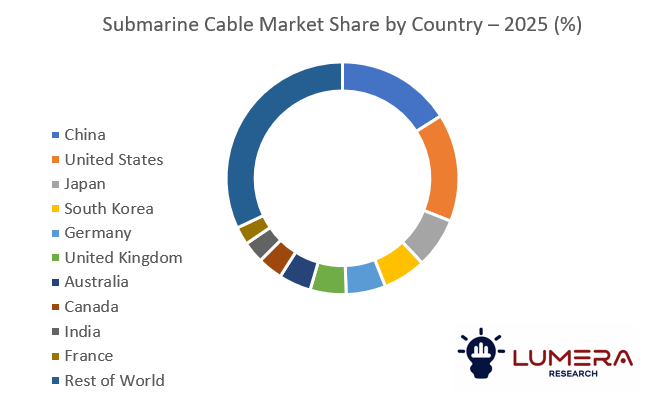
- Asia Pacific – Largest and fastest-growing region driven by rising internet penetration, regional data center expansion, and increasing cross-border connectivity projects involving Southeast Asia, China, Japan, and India.
- North America – Strong growth supported by hyperscale cloud providers, private cable investments, and high data traffic between the U.S., Europe, and Asia.
- Europe – Steady expansion fueled by digital transformation initiatives, data sovereignty requirements, and increased interconnectivity with Africa and the Middle East.
- Middle East & Africa – Emerging growth region supported by investments in international connectivity hubs and rising demand for digital infrastructure.
- Latin America – Growth driven by improved regional connectivity, cloud adoption, and new cable links with North America and Europe.
Market Size & Growth Outlook:
- Market Size (2026): ~USD 15.5–16.5 Billion
- Market Size (2036): ~USD 38.0–41.0 Billion
- CAGR (2026–2036): ~9.5–10.0%
Growth is supported by large-scale transoceanic cable deployments, increased private investment from hyperscalers, and rising bandwidth requirements across emerging and developed regions.
Key Players (Selected):
- SubCom
- NEC Corporation
- Alcatel Submarine Networks
- Prysmian Group
- Hengtong Marine Cable Systems
- NKT
- Huawei Marine Networks
- Orange Marine
- TE SubCom
- Fujitsu
- Meta Platforms
- Microsoft
- Amazon Web Services
- China Telecom