Overview:
The global Open Banking market is poised for substantial growth from 2026 through 2036 as financial institutions, fintech companies, and digital platforms accelerate adoption of API-based data sharing and service integration models. The market is estimated at approximately USD ~48.3–50.0 billion in 2026 and is projected to reach USD ~600–650+ billion by 2036, expanding at a compound annual growth rate (CAGR) of ~25–27% over the forecast period.
Open Banking enables secure, standardized sharing of customer financial data between banks and authorized third-party providers to deliver personalized services, integrated payment solutions, and broader financial ecosystems. Adoption is fueled by regulatory mandates, consumer demand for digital financial services, and the growth of embedded finance across non-bank platforms.
Leading Segment:
API-Driven Financial Services
API-Driven Financial Services represent the leading segment in the global Open Banking market. This segment’s dominance stems from its core role in enabling connectivity between traditional banks and third-party service providers, facilitating seamless access to account information, payment initiation, and value-added services.
APIs form the foundational enabler of Open Banking, allowing secure, real-time data exchange that underpins digital payments, personalized financial products, and fintech-bank collaboration. The rapid expansion of API ecosystems supports innovation in mobile banking, lending, wealth management, and embedded finance solutions. With financial institutions and fintechs increasingly relying on API frameworks for interoperability, service monetization, and customer experience enhancement, API-Driven Financial Services maintain the highest revenue share and adoption rate within the Open Banking market.
Market Drivers:
- Regulatory mandates requiring data sharing and interoperability across banks and third parties.
- Increasing consumer preference for personalized and digital financial services.
- Rapid adoption of cloud platforms and API management technologies.
- Growth of embedded finance and fintech-bank partnerships.
- Expansion of digital payments and real-time financial services.
Market Restraints:
- Data privacy and security concerns arising from increased data accessibility.
- Fragmented regulatory frameworks across regions and jurisdictions.
- Legacy banking systems and integration challenges.
- Consumer trust barriers in sharing financial data with third parties.
Regional Dynamics:
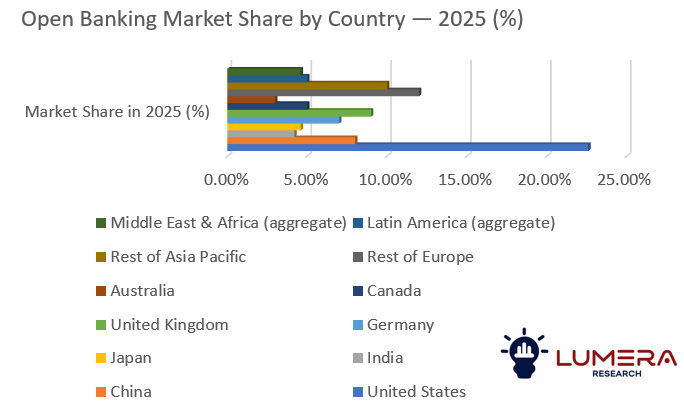
- North America – A leading market driven by strong fintech innovation, mobile banking penetration, and increasing adoption of open finance models.
- Europe – A strong growth region supported by regulatory frameworks such as PSD2 and consumer data rights provisions, encouraging open API adoption.
- Asia Pacific – Expected to exhibit rapid expansion due to digital banking growth, rising fintech ecosystems, and accelerating API investments in China, India, and Southeast Asia.
- Latin America – Emerging opportunities supported by fintech-led financial inclusion and digital payment innovation.
- Middle East & Africa – Gradual adoption spurred by infrastructure modernization and increasing digital financial services usage.
Quick Market Figures:
- 2026 Market Size (Estimated): ~USD 48.3–50.0 Billion
- 2036 Market Size (Projected): ~USD 600–650+ Billion
- CAGR (2026–2036): ~25–27%
- Leading Segment: API-Driven Financial Services
- Fastest-Growing Regions: Asia Pacific & North America
Key Companies (Representative List):
- Plaid
- Tink
- TrueLayer
- Yapily
- Token
- Nordigen
- Finicity
- Envestnet Yodlee
- FIS
- Fiserv
- Mastercard Open Banking Services
- Oracle Financial Services
- Capgemini Open Banking Solutions
- BBVA Open Platform
- Capital One Open Banking Initiatives