Global Tire Pressure Monitoring System (TPMS) Market Size, Share & Industry Analysis, By Type, By Component, By Vehicle Type, By Propulsion, By Sales Channel, By Region, Forecast 2026–2035
Overview
The Global Tire Pressure Monitoring System (TPMS) Market represents the ecosystem of electronic systems, sensors, control units, communication modules, software, and related components used to monitor tire pressure and communicate tire-pressure information to vehicle occupants or vehicle control systems.
TPMS has become an important vehicle safety technology because under-inflated tires can negatively affect vehicle handling, braking performance, tire life, and fuel or energy efficiency. Direct TPMS systems use pressure sensors installed inside or around the tire to provide real-time pressure information, while indirect systems estimate pressure changes using wheel-speed and other vehicle data.
The market is increasingly moving toward intelligent and connected TPMS solutions. Modern systems can integrate with vehicle electronic architectures, telematics platforms, mobile applications, fleet-management systems, and predictive-maintenance solutions. This evolution is creating opportunities beyond basic pressure warnings, including tire-health monitoring, fleet optimization, predictive maintenance, and connected vehicle services.
Regulatory requirements remain a major source of demand. Mandatory or expanding TPMS requirements across major automotive markets are supporting OEM installation volumes, while replacement demand from the growing installed vehicle base is supporting the aftermarket.
Market Size & Growth Outlook
Market Size & Growth Outlook: The Global Tire Pressure Monitoring System Market is projected to grow from approximately USD 8.0 Billion in 2025 to nearly USD 15.9 Billion by 2035, representing a CAGR of approximately 7.5% during 2026–2035.
The growth outlook is supported by increasing vehicle production, regulatory requirements, rising adoption of connected vehicles, and growing demand for advanced safety technologies. Recent market estimates also indicate that direct TPMS represents the dominant technology segment, while OEM installations account for the majority of current demand.
The increasing adoption of electric vehicles is creating another growth opportunity. Tire pressure has a direct relationship with rolling resistance and vehicle energy efficiency, making accurate tire monitoring increasingly relevant to EV manufacturers and users. TPMS data can also become part of broader vehicle energy-management and predictive-maintenance systems.
The aftermarket is expected to remain important as installed TPMS sensors reach the end of their operating life and vehicle owners require replacement sensors, service tools, calibration, and retrofit solutions. Industry research indicates that aftermarket channels are expected to experience faster growth than OEM channels in several regional markets.
Quick Market Figures
- Base Year: 2025
- Forecast Period: 2026–2035
- Base Year Market Size: USD 8.0 Billion
- Forecast Market Size: USD 15.9 Billion
- CAGR: 7.5%
- Leading Segment: Direct TPMS
- Fastest-Growing Region: Asia Pacific
Leading Segment
By Type – Direct TPMS: Direct TPMS represents the leading segment of the global market because it provides direct measurement of tire pressure through sensors installed within the tire or valve assembly. Direct systems generally provide greater measurement accuracy and real-time pressure information compared with indirect systems.
Recent industry estimates indicate that direct TPMS accounted for approximately 64% of the global market in 2025. Its adoption is supported by regulatory requirements, increasing vehicle safety expectations, and integration with advanced vehicle electronics.

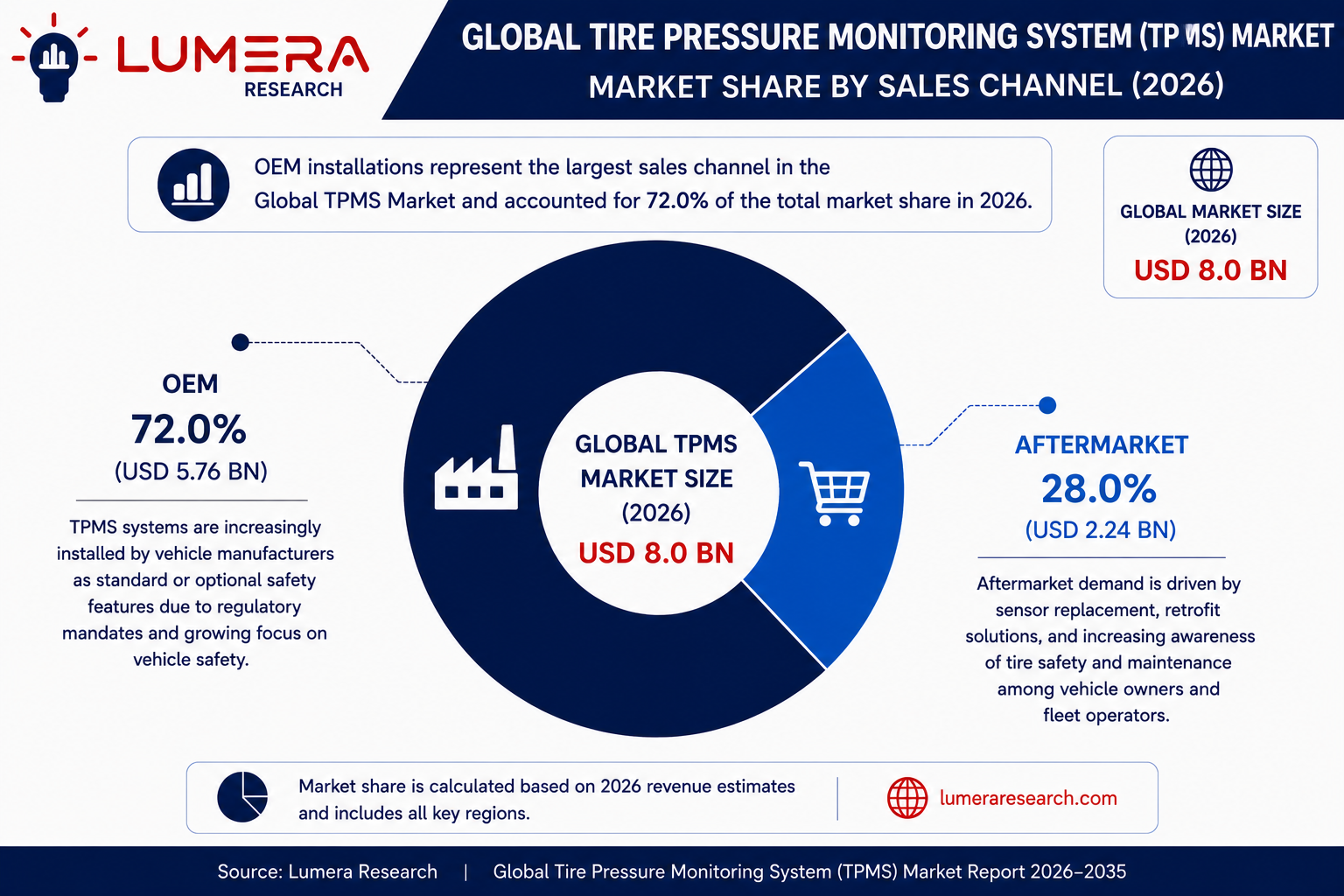
By Sales Channel – OEM: OEM installation represents the largest sales channel because TPMS is increasingly integrated into new vehicles as part of standard safety and electronic architecture. Regulatory requirements and vehicle manufacturers’ focus on safety technologies continue to support factory-fitted TPMS demand.
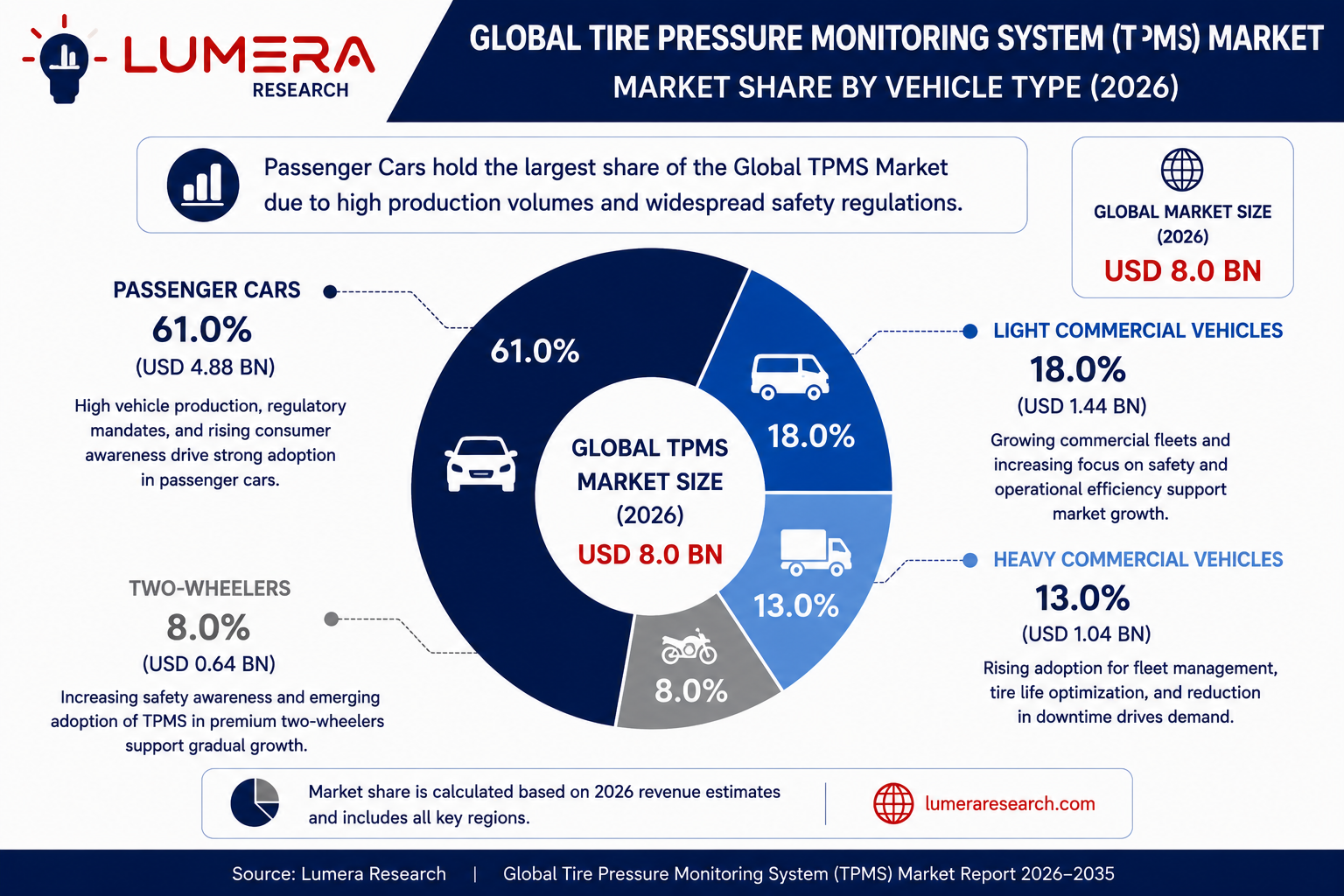
By Vehicle Type – Passenger Cars: Passenger cars represent the largest vehicle segment because of their high global production volumes, widespread regulatory adoption, and increasing integration of electronic safety systems. Commercial vehicles are also becoming an important opportunity as fleet operators increasingly use TPMS data for safety, maintenance, and operating-cost optimization.
Market Drivers
Increasing Vehicle Safety Regulations: Government regulations requiring tire-pressure monitoring in new vehicles remain one of the most important drivers of market growth. Regulatory adoption across North America, Europe, Asia, and other markets is creating sustained OEM demand.
Growing Vehicle Production: Rising global vehicle production directly increases demand for factory-installed TPMS systems. Increasing production in Asia Pacific is particularly important because of the region’s large automotive manufacturing base.
Growing Electric Vehicle Adoption: EV manufacturers are increasingly focused on tire efficiency because rolling resistance affects driving range. Accurate pressure monitoring can therefore contribute to vehicle efficiency and range management.
Increasing Connected Vehicle Adoption: TPMS is increasingly being integrated with connected vehicle systems, telematics platforms, mobile applications, and fleet-management solutions, expanding the value of tire-pressure data beyond basic driver alerts.
Rising Consumer Awareness: Growing awareness of road safety, tire maintenance, fuel efficiency, and vehicle operating costs is encouraging consumers and fleet operators to adopt tire-monitoring technologies.
Expansion of Commercial Vehicle Fleets: Logistics, transportation, and fleet operators are increasingly adopting TPMS to monitor tire conditions, reduce unplanned downtime, improve safety, and optimize maintenance schedules.
Advancements in Sensor Technology: Improvements in MEMS sensors, wireless communication, battery life, sensor miniaturization, and low-power electronics are improving TPMS performance and creating opportunities for next-generation systems.
Market Restraints
High Replacement and Sensor Costs: Direct TPMS systems can involve higher component and replacement costs because each wheel may require a dedicated sensor and associated service procedures.
Sensor Battery Limitations: Battery-powered sensors have a finite operating life, creating replacement requirements and additional maintenance costs for vehicle owners.
Complex Aftermarket Installation: Replacement and retrofit TPMS systems may require specialized diagnostic tools, sensor programming, relearning, and calibration, increasing service complexity.
Compatibility Challenges: Differences in vehicle architectures, communication frequencies, sensor protocols, and electronic systems can create compatibility challenges across vehicle models.
Limited Adoption in Some Emerging Markets: Cost sensitivity, limited regulatory enforcement, and lower consumer awareness can slow TPMS adoption in certain developing automotive markets.
Supply Chain Dependencies: TPMS manufacturers depend on semiconductor components, MEMS sensors, electronic components, batteries, and specialized automotive electronics, exposing the industry to component supply disruptions.
Market Opportunities
Connected TPMS Solutions: Integration with cloud platforms, mobile applications, telematics, and connected vehicle systems can transform TPMS from a safety warning system into a broader tire-health and vehicle-monitoring platform.
Predictive Tire Maintenance: Advanced analytics can combine tire-pressure information with temperature, mileage, vehicle usage, and historical data to identify potential tire failures and optimize maintenance schedules.
Electric Vehicle Applications: Increasing EV adoption creates opportunities for advanced TPMS solutions that integrate tire-pressure information with vehicle energy management and range optimization systems.
Commercial Fleet Management: Fleet operators can use TPMS data to reduce tire-related downtime, improve fuel efficiency, increase safety, and optimize tire replacement cycles.
Aftermarket Replacement Demand: The growing installed base of TPMS-equipped vehicles creates recurring opportunities for replacement sensors, universal programmable sensors, diagnostic equipment, service tools, and retrofit systems.
Advanced Sensor Technologies: MEMS, BLE, low-power wireless communication, battery-less sensing, and miniaturized electronics are creating opportunities for innovative TPMS products.
Integration with Advanced Vehicle Systems: TPMS can increasingly interact with ADAS, vehicle telematics, predictive maintenance, and broader vehicle-health monitoring platforms.
Regional Insights
North America: North America represents a major TPMS market due to established vehicle safety requirements, high vehicle ownership, mature automotive manufacturing, and widespread adoption of electronic vehicle safety systems. The region also offers a substantial aftermarket opportunity because of its large installed vehicle fleet. Recent industry estimates identify North America as a leading global market, while Asia Pacific is expected to experience faster growth.
Europe: Europe remains an important TPMS market supported by stringent vehicle safety requirements, established automotive OEMs, high adoption of advanced vehicle technologies, and increasing electrification. The region’s emphasis on vehicle safety and emissions efficiency supports continued demand for accurate tire-pressure monitoring.
Asia Pacific: Asia Pacific is expected to remain the fastest-growing regional market due to high vehicle production volumes, expanding vehicle ownership, increasing safety regulations, and rapid growth in China, India, Japan, and South Korea. Recent market estimates place Asia Pacific at approximately 39% of the global TPMS market, while regional automotive TPMS research highlights strong growth in direct systems and OEM factory-fitted installations.
Latin America: Latin America is expected to witness moderate growth as vehicle production, vehicle ownership, road transportation, and aftermarket automotive services expand. Increasing awareness of vehicle safety and the gradual adoption of advanced automotive technologies are expected to support market development.
Middle East & Africa: The Middle East & Africa market is expected to grow gradually as vehicle fleets expand, automotive safety technologies become more widely adopted, and fleet operators increasingly focus on tire maintenance and operating efficiency.
Key Companies
- Continental AG
- Robert Bosch GmbH
- DENSO Corporation
- Sensata Technologies Holding plc
- ZF Friedrichshafen AG
- Valeo SE
- Huf Hülsbeck & Fürst Co.
- HELLA GmbH & Co. KGaA
- Pacific Industrial Co., Ltd.
- Hyundai Mobis Co., Ltd.
- Hitachi Astemo, Ltd.
- ATEQ
- NXP Semiconductors N.V.
- Infineon Technologies AG
- Murata Manufacturing Co., Ltd.
Customization & Consulting Support
Customization & Consulting Support: Customized research and consulting services are available to support specific business intelligence, automotive strategy, product development, investment planning, and market expansion requirements related to the Global Tire Pressure Monitoring System (TPMS) Market.
Available services include:
- Country-level TPMS market analysis
- Regional market sizing
- Competitive benchmarking
- Automotive sensor technology analysis
- TPMS vendor profiling
- OEM and aftermarket analysis
- Supply chain mapping
- Pricing analysis
- Regulatory landscape assessment
- Electric vehicle TPMS analysis
- Go-to-market strategy advisory
- Custom market sizing and forecasting
- Investment opportunity assessment
Data Sources
The Global Tire Pressure Monitoring System (TPMS) Market report is developed using a combination of Primary Research and Secondary Research methodologies to provide comprehensive and reliable market intelligence.
Primary Research
- Interviews with automotive OEM executives
- Discussions with TPMS manufacturers
- Consultations with automotive sensor suppliers
- Interviews with tire manufacturers and distributors
- Discussions with aftermarket service providers
- Consultations with fleet operators
- Interviews with automotive technology experts
Secondary Research
- Company annual reports and financial filings
- Automotive industry association publications
- Government vehicle safety regulations
- Transportation and automotive databases
- Regulatory agency publications
- Automotive trade journals
- Technical publications and white papers
- Company investor presentations
- Product documentation
- Patent databases
- Company press releases
- Market intelligence databases
Who This Report Is For
- Automotive OEMs
- TPMS Manufacturers
- Automotive Sensor Manufacturers
- Tire Manufacturers
- Automotive Component Suppliers
- Automotive Electronics Companies
- Electric Vehicle Manufacturers
- Commercial Fleet Operators
- Automotive Aftermarket Companies
- Automotive Service Providers
- Technology Providers
- Investors
- Private Equity Firms
- Venture Capital Firms
- Strategy Consultants
- Government Agencies
- Industry Stakeholders
Why Buy This Report
Comprehensive Market Intelligence: Gain detailed insights into the current market structure, growth prospects, competitive environment, and emerging trends within the Global Tire Pressure Monitoring System Market.
Reliable Market Forecasts: Access market forecasts through 2035 covering TPMS type, components, vehicle categories, propulsion systems, sales channels, and regional markets.
Detailed Segmentation Analysis: Identify high-growth opportunities across direct and indirect TPMS, passenger and commercial vehicles, EVs, OEM installations, and aftermarket applications.
Regulatory & Safety Insights: Understand the impact of vehicle safety regulations and mandatory tire-pressure monitoring requirements on TPMS adoption across major automotive markets.
Competitive Benchmarking: Evaluate leading TPMS manufacturers based on product portfolios, technology capabilities, strategic initiatives, geographic presence, and competitive positioning.
Technology & Innovation Insights: Assess developments in MEMS sensors, wireless communication, connected TPMS, predictive maintenance, smart tires, and integration with vehicle electronic systems.
EV & Connected Vehicle Opportunities: Understand how vehicle electrification and connected vehicle adoption are creating new applications for tire-pressure and tire-health monitoring technologies.
Strategic Decision Support: Identify emerging market opportunities, regional demand trends, technology developments, and aftermarket opportunities to support business expansion and investment decisions.
Explore More Reports
Explore additional market intelligence reports from Lumera Research covering: https://lumeraresearch.com/market-research-reports/