Global Smart Tire Market Size, Share & Industry Analysis, By Technology, By Sensor Type, By Vehicle Type, By Propulsion, By Connectivity, By Sales Channel, By Region, Forecast 2026–2035
Overview
The Global Smart Tire Market represents the ecosystem of intelligent tire technologies that use embedded or externally integrated sensors, electronic components, wireless communication, and software analytics to monitor tire and road conditions in real time.
Unlike conventional tires, smart tires can provide information related to pressure, temperature, tread wear, load, road surface conditions, and tire performance. This information can be transmitted to vehicle electronic control units, fleet-management platforms, cloud applications, or other connected vehicle systems.
The market is evolving from basic tire-pressure monitoring toward multifunctional tire intelligence. Manufacturers and technology providers are increasingly developing systems that combine multiple sensing capabilities with connectivity and analytics. This transition is particularly important for commercial fleets, electric vehicles, connected cars, and autonomous driving systems.
Smart tire technology is also becoming an important component of predictive maintenance. By continuously monitoring tire conditions, vehicle owners and fleet operators can identify potential issues earlier, reduce unexpected downtime, improve tire utilization, and optimize replacement schedules. Current industry research highlights pressure, temperature, wear/load, and road-condition sensing as key technology areas within the smart tire ecosystem.
Market Size & Growth Outlook
Market Size & Growth Outlook: The Global Smart Tire Market is projected to grow from approximately USD 1.8 Billion in 2025 to nearly USD 4.6 Billion by 2035, registering a CAGR of approximately 9.8% during 2026–2035.
Market growth is supported by increasing demand for connected vehicle technologies, advanced tire monitoring systems, automotive safety solutions, and fleet-management applications. The transition toward software-defined and connected vehicles is also increasing the importance of real-time tire data.
Smart tire technology is expected to become increasingly relevant to electric vehicles because tire pressure, rolling resistance, temperature, and tire condition can influence vehicle efficiency and driving range. Integration with vehicle energy-management systems and predictive maintenance platforms is therefore creating additional growth opportunities.
The market is also moving toward data-driven business models. Fleet operators and tire manufacturers are increasingly combining sensor data with analytics platforms to optimize tire lifecycle management, vehicle uptime, and operating costs. Emerging connected TPMS and smart tire platforms demonstrate this shift from standalone hardware toward data-enabled services.
Quick Market Figures
- Base Year: 2025
- Forecast Period: 2026–2035
- Base Year Market Size: USD 1.8 Billion
- Forecast Market Size: USD 4.6 Billion
- CAGR: 9.8%
- Leading Segment: Pressure Monitoring Technology
- Leading Vehicle Segment: Passenger Vehicles
- Fastest-Growing Region: Asia Pacific
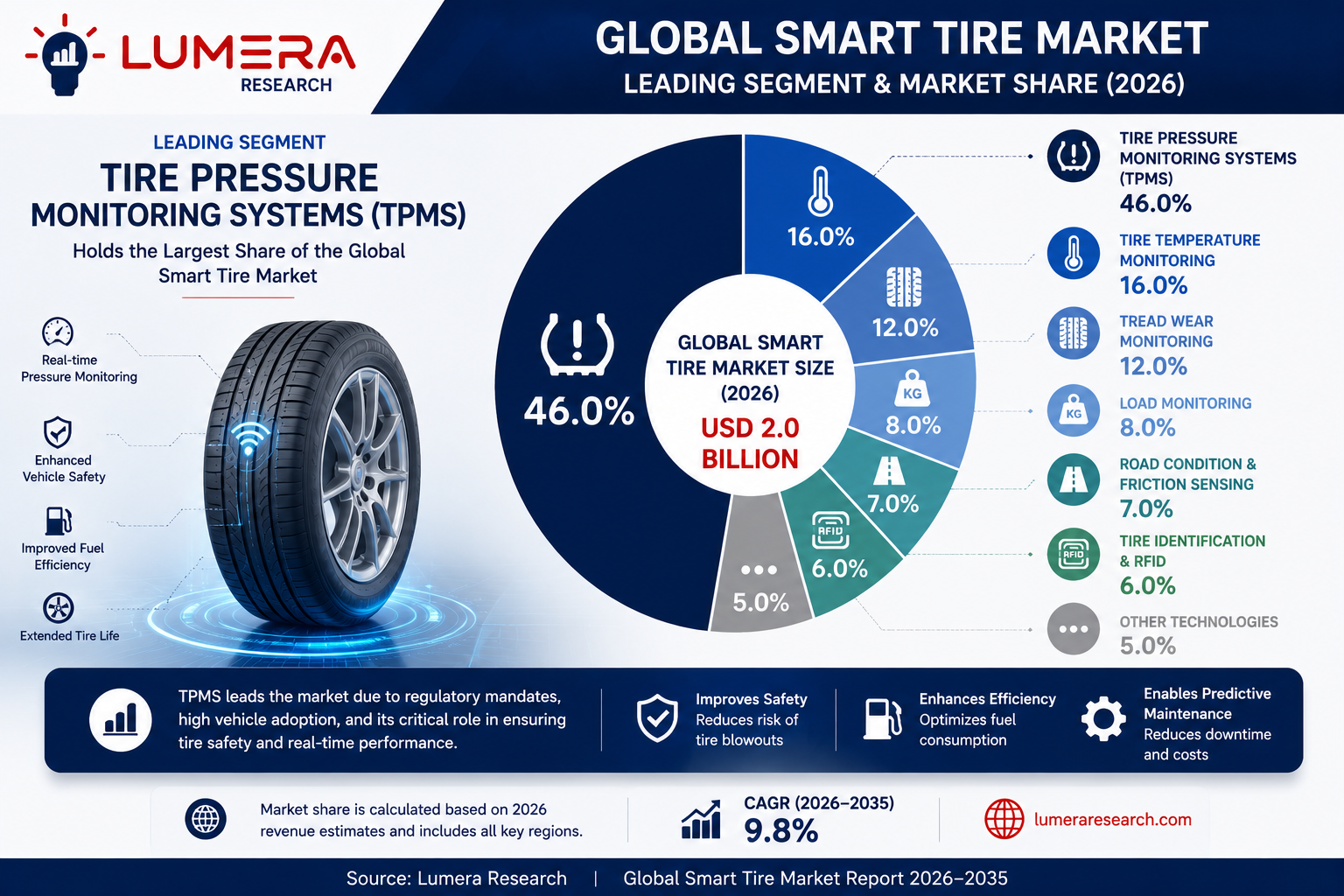
Leading Segment
By Technology – Pressure Monitoring: Pressure monitoring represents the leading technology segment within the smart tire market. Tire pressure monitoring systems have established a strong installed base because of vehicle safety regulations and their ability to provide real-time information about tire inflation.
Industry estimates indicate that TPMS accounted for approximately 46.6% of the smart tire technology market in 2024. However, newer technologies such as road-condition sensing, tread wear monitoring, and multi-parameter sensing are expanding rapidly as vehicle manufacturers seek more comprehensive tire intelligence.
By Sensor Type – Embedded Sensors: Embedded sensing technologies represent a major component of smart tire systems because they enable continuous collection of tire-level information. Pressure, temperature, load, tread, acceleration, and road-condition sensors can be integrated into increasingly sophisticated tire monitoring platforms.
By Vehicle Type – Passenger Vehicles: Passenger vehicles represent the leading vehicle segment due to high global vehicle volumes, increasing adoption of connected vehicle technologies, and growing integration of electronic safety systems. Fact.MR estimates passenger vehicles accounted for approximately 60% of the smart tire market in 2025.
Market Drivers
Increasing Vehicle Safety Requirements: Regulatory requirements and growing emphasis on vehicle safety are encouraging the adoption of tire monitoring technologies. TPMS has created the foundation for broader smart tire adoption across major automotive markets.
Growth of Connected Vehicles: Connected vehicles increasingly rely on real-time sensor data. Smart tires can provide valuable tire-level information to vehicle control systems, telematics platforms, and cloud-based applications.
Electric Vehicle Adoption: EVs are creating additional demand for intelligent tire technologies because tire pressure, temperature, rolling resistance, and condition can affect vehicle efficiency and driving range.
Growth of Fleet Management: Commercial fleet operators are increasingly using real-time tire data to reduce downtime, improve safety, optimize maintenance, and control operating costs.
Increasing Demand for Predictive Maintenance: Smart tire data can help identify abnormal tire behavior and potential failures before they result in breakdowns or safety incidents.
Advancement in Sensor Technologies: MEMS sensors, RFID, wireless communication, low-power electronics, and sensor miniaturization are expanding the capabilities of smart tires.
Expansion of ADAS and Autonomous Driving: Advanced driving systems require increasingly detailed information about vehicle-road interaction. Road-condition, tire-grip, and friction data can potentially support advanced vehicle control systems. Road-condition sensing has been identified as one of the faster-growing smart tire technology areas.
Market Restraints
High Technology and Integration Costs: Smart tires require sensors, electronic components, communication modules, and software, increasing costs compared with conventional tires.
Sensor Durability Challenges: Sensors integrated into tires must operate reliably under high vibration, temperature variations, mechanical stress, moisture, and repeated deformation.
Complex Installation and Maintenance: Smart tire systems may require specialized equipment, calibration, sensor replacement, and software integration.
Data Integration Challenges: Integrating tire data with vehicle electronic architectures, telematics platforms, fleet-management systems, and cloud applications can create technical complexity.
Limited Consumer Awareness: Many consumers remain unfamiliar with the broader capabilities of smart tires beyond conventional tire-pressure monitoring.
Cybersecurity and Data Privacy: Connected tire systems generate vehicle and operational data that may create cybersecurity and data-governance requirements.
Higher Replacement Costs: Sensor-enabled tires and smart tire components may carry higher replacement costs, potentially limiting adoption in price-sensitive markets.
Market Opportunities
Connected Smart Tire Platforms: Integration of tire sensors with cloud platforms, mobile applications, telematics, and fleet-management systems can create recurring software and data-service opportunities.
Predictive Tire Maintenance: Combining sensor data with AI and analytics can enable predictive identification of tire wear, pressure loss, temperature abnormalities, and other potential failures.
Road-Condition Monitoring: Smart tires capable of detecting road surface characteristics and tire-road friction could support ADAS and autonomous vehicle applications. Mordor Intelligence identifies road-condition sensing as a high-growth technology area within smart tires.
RFID-Enabled Tire Lifecycle Management: RFID technologies can provide tire identification and lifecycle traceability, creating opportunities for fleet management, maintenance optimization, inventory tracking, and recycling.
Electric Vehicle Applications: Smart tires can support EV efficiency and range optimization by providing real-time tire condition data to vehicle management systems.
Commercial Fleet Optimization: Fleet operators can use smart tire data to reduce tire-related downtime, improve fuel or energy efficiency, and optimize tire replacement cycles.
AI-Based Tire Analytics: AI can combine tire sensor information with vehicle, weather, road, and historical data to generate predictive insights and automated maintenance recommendations.
Smart Tire-as-a-Service Models: Tire manufacturers and technology providers can increasingly monetize tire data through subscription-based monitoring, fleet analytics, predictive maintenance, and performance-based services.
Regional Insights
North America: North America represents a significant smart tire market supported by advanced automotive technologies, connected vehicle adoption, mature fleet-management systems, and strong demand for vehicle safety solutions. The region also has an established ecosystem of tire manufacturers, automotive technology companies, and fleet operators. Current industry research identifies North America as a leading smart tire region.
Europe: Europe remains an important market due to strong automotive manufacturing capabilities, vehicle safety requirements, sustainability initiatives, and rapid adoption of connected and electric vehicles. European tire manufacturers are also investing in sensor-enabled tires, predictive maintenance, and digital tire-management platforms.
Asia Pacific: Asia Pacific is expected to register strong growth during the forecast period, supported by expanding vehicle production, increasing EV adoption, growing automotive electronics manufacturing, and rising adoption of connected vehicle technologies. China, Japan, South Korea, and India represent important markets for smart tire technology.
Latin America: Latin America is expected to experience moderate growth as vehicle ownership, commercial transportation, fleet management, and automotive technology adoption expand. Aftermarket opportunities are expected to remain important across the region.
Middle East & Africa: Increasing vehicle ownership, commercial fleet expansion, road transportation activity, and adoption of advanced automotive safety technologies are expected to support gradual smart tire market development.
Key Companies
- Michelin
- Bridgestone Corporation
- The Goodyear Tire & Rubber Company
- Continental AG
- Pirelli & C. S.p.A.
- The Yokohama Rubber Co., Ltd.
- Sumitomo Rubber Industries, Ltd.
- Hankook Tire & Technology
- Goodyear Tire & Rubber Company
- Nokian Tyres plc
- Sensata Technologies
- Infineon Technologies AG
- NXP Semiconductors N.V.
- Robert Bosch GmbH
- ZF Friedrichshafen AG
Customization & Consulting Support
Customization & Consulting Support: Customized research and consulting services are available to support automotive strategy, product development, competitive intelligence, investment planning, market entry, and technology assessment requirements within the Global Smart Tire Market.
Available services include:
- Country-level smart tire market analysis
- Regional market sizing
- Competitive benchmarking
- Smart tire technology landscape analysis
- Sensor technology assessment
- Automotive OEM analysis
- Tire manufacturer profiling
- Fleet market analysis
- Aftermarket opportunity assessment
- Supply chain mapping
- Pricing analysis
- Regulatory landscape analysis
- Technology benchmarking
- Go-to-market strategy advisory
- Custom market sizing and forecasting
- Investment opportunity assessment
Data Sources
The Global Smart Tire Market report is developed using a combination of Primary Research and Secondary Research methodologies to provide comprehensive and reliable market intelligence.
Primary Research
- Interviews with tire manufacturer executives
- Discussions with automotive OEMs
- Consultations with smart tire technology providers
- Interviews with automotive sensor manufacturers
- Discussions with fleet operators
- Consultations with automotive electronics specialists
- Interviews with tire distributors and aftermarket service providers
- Discussions with connected vehicle and telematics companies
Secondary Research
- Company annual reports and financial filings
- Tire manufacturer publications
- Automotive industry association reports
- Government transportation databases
- Vehicle safety regulations
- Automotive technology publications
- Technical journals and research papers
- Company investor presentations
- Product documentation
- Patent databases
- Industry trade publications
- Company press releases
- Market intelligence databases
Who This Report Is For
- Tire Manufacturers
- Automotive OEMs
- Smart Tire Technology Providers
- Automotive Sensor Manufacturers
- Automotive Electronics Companies
- EV Manufacturers
- Commercial Fleet Operators
- Fleet Management Companies
- Automotive Aftermarket Companies
- Tire Distributors
- Automotive Service Providers
- Telematics Companies
- Connected Vehicle Technology Providers
- Investors
- Private Equity Firms
- Venture Capital Firms
- Strategy Consultants
- Government Agencies
- Industry Stakeholders
Why Buy This Report
Comprehensive Market Intelligence: Gain detailed insights into the current structure, growth prospects, competitive environment, technology developments, and future outlook of the Global Smart Tire Market.
Reliable Market Forecasts: Access market forecasts through 2035 covering technology, sensor type, vehicle type, propulsion, connectivity, sales channel, and regional markets.
Detailed Segmentation Analysis: Identify high-growth opportunities across pressure monitoring, temperature sensing, tread monitoring, load sensing, road-condition monitoring, RFID, and other smart tire technologies.
Technology Intelligence: Understand the evolution of connected tires, embedded sensors, wireless communication, AI-based tire analytics, predictive maintenance, and tire-road condition monitoring.
Competitive Benchmarking: Evaluate leading tire manufacturers and technology providers based on product portfolios, technology capabilities, strategic initiatives, geographic presence, and competitive positioning.
EV & Autonomous Vehicle Insights: Assess how vehicle electrification and autonomous driving are increasing demand for advanced tire sensing, tire-road friction information, and real-time vehicle data.
Fleet & Aftermarket Opportunities: Identify opportunities in commercial fleet management, predictive maintenance, tire lifecycle management, replacement sensors, connected tire services, and aftermarket applications.
Strategic Decision Support: Identify emerging technologies, regional opportunities, market trends, investment areas, and competitive developments to support business expansion and strategic planning.
Explore More Reports
Explore additional market intelligence reports from Lumera Research covering: https://lumeraresearch.com/market-research-reports/