Global High Bandwidth Memory (HBM) Market Size, Share & Industry Analysis, By Memory Type (HBM2, HBM2E, HBM3, HBM3E, Next-Generation HBM), By Application (AI Accelerators, GPUs, High-Performance Computing, Data Centers, Networking, Consumer Electronics), By End User, By Region, Forecast 2026–2035
Overview
The Global High Bandwidth Memory (HBM) Market has emerged as one of the fastest-growing segments within the semiconductor industry due to increasing demand for AI computing, graphics processing, cloud infrastructure, and high-performance computing systems. HBM is an advanced memory architecture that delivers exceptional bandwidth, lower latency, and improved power efficiency by stacking multiple DRAM dies using through-silicon vias (TSVs).
As AI workloads become increasingly complex, conventional memory technologies struggle to meet the bandwidth requirements of modern GPUs and AI accelerators. HBM has become a critical component in advanced AI chips developed by companies such as NVIDIA, AMD, Intel, and custom AI processor vendors. Growing deployment of generative AI, large language models (LLMs), autonomous systems, and cloud AI services continues to drive demand for next-generation HBM solutions.
Market Size & Growth Outlook
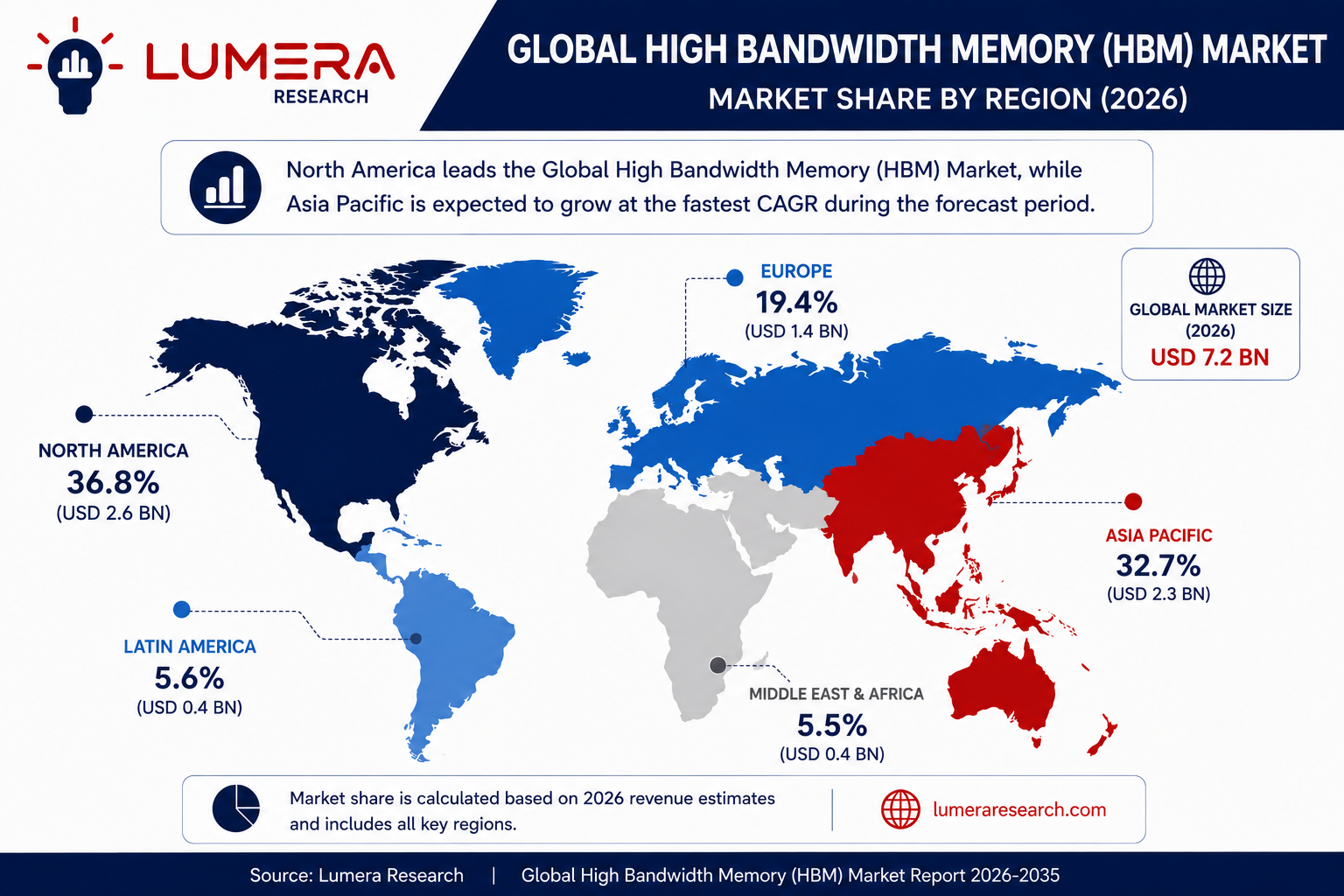
Market Size & Growth Outlook: The Global High Bandwidth Memory (HBM) Market is projected to grow from approximately USD 7.2 Billion in 2026 to nearly USD 41.8 Billion by 2035, registering a CAGR of 21.6% during the forecast period.
The market is expected to expand significantly due to increasing production of AI accelerators, advanced GPUs, data center processors, and high-performance computing systems requiring extremely high memory bandwidth. Rising investments in semiconductor manufacturing capacity and advanced packaging technologies are also expected to contribute to long-term market growth.
Quick Market Figures
- Base Year: 2025
- Forecast Period: 2026–2035
- Base Year Market Size: USD 7.2 Billion
- Forecast Market Size: USD 41.8 Billion
- CAGR: 21.6%
- Leading Segment: HBM3 & HBM3E
- Fastest-Growing Region: Asia Pacific
Leading Segment
By Memory Type – HBM3 & HBM3E: HBM3 and HBM3E currently represent the leading market segment owing to their superior bandwidth, improved energy efficiency, and widespread adoption in AI accelerators, hyperscale cloud infrastructure, and next-generation graphics processors. These memory technologies are increasingly integrated into AI chips supporting generative AI applications and large-scale machine learning workloads.
Market Drivers
Rapid Expansion of Artificial Intelligence
The rapid commercialization of generative AI, large language models, and enterprise AI applications is driving unprecedented demand for high-bandwidth memory capable of supporting massive computational workloads.
Growing GPU and AI Accelerator Shipments
Increasing production of AI GPUs and specialized accelerators requires advanced memory solutions capable of delivering significantly higher bandwidth than conventional DRAM.
Expansion of Hyperscale Data Centers
Cloud providers continue investing in AI infrastructure and data centers equipped with advanced processors utilizing HBM technology.
Advancements in High-Performance Computing
Scientific research, weather modeling, defense simulations, and financial analytics increasingly rely on HPC systems integrating HBM for superior computational performance.
Growing Demand for Energy-Efficient Memory
HBM provides improved power efficiency compared to traditional memory technologies, helping reduce energy consumption in AI infrastructure.
Market Restraints
High Manufacturing Costs
HBM manufacturing involves complex 3D stacking technologies and advanced semiconductor packaging processes, resulting in higher production costs.
Limited Manufacturing Capacity
Global production capacity for HBM remains constrained due to limited advanced packaging facilities and complex manufacturing requirements.
Supply Chain Dependencies
The market relies heavily on specialized semiconductor materials, advanced packaging technologies, and high-end fabrication facilities, making supply chains susceptible to disruptions.
Technical Complexity
Developing HBM solutions requires sophisticated semiconductor design expertise and advanced manufacturing capabilities, creating high barriers to entry.
Market Opportunities
Generative AI Infrastructure
The rapid deployment of generative AI platforms is expected to create significant long-term opportunities for HBM manufacturers.
Advanced AI Accelerators
Increasing demand for next-generation AI chips presents strong opportunities for HBM adoption across cloud computing and enterprise AI applications.
High-Performance Computing Expansion
Governments and research institutions continue investing in supercomputers that require advanced memory technologies.
Advanced Packaging Technologies
Innovations in CoWoS, 2.5D packaging, 3D stacking, and chiplet integration are expected to support broader HBM adoption.
Automotive AI Systems
Future autonomous vehicles and intelligent transportation systems may increasingly utilize HBM-enabled processors for real-time AI processing.
Regional Insights
North America
North America holds a significant share of the Global High Bandwidth Memory Market due to the presence of leading AI chip designers, cloud service providers, and major investments in AI infrastructure. Strong demand from hyperscale data centers and semiconductor innovation continues to support regional market growth.
Europe
Europe is experiencing steady market growth driven by investments in high-performance computing, semiconductor research, digital transformation initiatives, and AI technology development.
Asia Pacific
Asia Pacific is projected to register the fastest growth during the forecast period owing to the concentration of semiconductor manufacturing facilities, increasing AI infrastructure investments, government support for domestic chip production, and the presence of leading memory manufacturers in South Korea, Japan, Taiwan, and China.
Latin America
The region is witnessing moderate growth supported by increasing cloud adoption, enterprise digital transformation, and expanding AI infrastructure investments.
Middle East & Africa
Growing investments in AI innovation, smart city projects, and digital infrastructure are expected to support gradual market expansion across the region.
Key Companies
- SK hynix Inc.
- Samsung Electronics Co., Ltd.
- Micron Technology, Inc.
- NVIDIA Corporation
- Advanced Micro Devices (AMD)
- Intel Corporation
- Taiwan Semiconductor Manufacturing Company (TSMC)
- ASE Technology Holding Co., Ltd.
- Amkor Technology, Inc.
- Broadcom Inc.
- Marvell Technology, Inc.
- Synopsys, Inc.
- Cadence Design Systems, Inc.
- Fujitsu Limited
- Rambus Inc.
Customization & Consulting Support
Customization & Consulting Support: Customized research and consulting services are available to support specific business intelligence, semiconductor strategy, investment planning, and product development initiatives within the Global High Bandwidth Memory (HBM) Market.
Available services include:
- Country-level market analysis
- Competitive benchmarking
- Semiconductor technology landscape analysis
- Memory ecosystem assessment
- Supply chain mapping
- Pricing analysis
- Go-to-market strategy advisory
- Vendor profiling
- Custom market sizing and forecasting
- Investment opportunity assessment
Data Sources
The Global High Bandwidth Memory (HBM) Market report is developed using a combination of Primary Research and Secondary Research methodologies to deliver comprehensive and reliable market intelligence.
Primary Research
- Interviews with semiconductor executives
- Discussions with memory manufacturers
- Consultations with AI hardware experts
- Interviews with cloud service providers
- Discussions with advanced packaging specialists
- Insights from data center operators and system integrators
Secondary Research
- Company annual reports and financial filings
- Semiconductor industry association publications
- Government semiconductor policy documents
- Trade journals and technical research publications
- Patent databases
- White papers
- Investor presentations
- Company press releases
- Industry databases and market intelligence sources
Who This Report Is For
- Memory Manufacturers
- Semiconductor Companies
- AI Chip Designers
- GPU Manufacturers
- Cloud Service Providers
- Data Center Operators
- Consumer Electronics Manufacturers
- Automotive OEMs
- Government Organizations
- Investors
- Venture Capital Firms
- Private Equity Firms
- Strategy Consultants
- Research Institutions
- Industry Stakeholders
Why Buy This Report
Comprehensive Market Intelligence: Gain detailed insights into the current market landscape, competitive dynamics, and future growth prospects of the Global High Bandwidth Memory (HBM) Market.
Reliable Market Forecasts: Support strategic planning with comprehensive market forecasts covering revenue, regional demand, and segment-level growth through 2035.
Detailed Segmentation Analysis: Identify high-growth opportunities across memory types, applications, end users, and geographic markets.
Competitive Benchmarking: Evaluate the market positioning, product portfolios, and strategic initiatives of leading HBM manufacturers and semiconductor companies.
Technology & Innovation Insights: Understand the impact of HBM3, HBM3E, advanced packaging, chiplets, CoWoS technology, and AI accelerator development on future market evolution.
Strategic Decision Support: Discover emerging investment opportunities, supply chain developments, and regional demand trends to support business expansion and long-term decision-making.
Explore More Reports
Explore additional market intelligence reports from Lumera Research: https://lumeraresearch.com/market-research-reports/