Overview:
The global Distributed Antenna Systems (DAS) Market is expected to witness steady growth from 2026 through 2036 due to increasing demand for enhanced wireless coverage, high-speed data connectivity, and capacity expansion across complex indoor and outdoor environments. DAS solutions address network congestion, signal blackspots, and performance issues in large venues by distributing radio frequency (RF) signals using a network of spatially separated antennas.
In 2026, the DAS market is estimated at approximately USD ~10.5–11.2 billion and is projected to reach USD ~18.3–19.5 billion by 2036, exhibiting a compound annual growth rate (CAGR) of ~5.8–6.3% over the forecast period.
Growth is driven by the proliferation of smartphones and IoT devices, rapid deployment of 5G networks, and rising demand for reliable connectivity across stadiums, airports, hospitals, commercial buildings, and industrial facilities.
Leading Segment:
Pico & Small Cell DAS
Pico & Small Cell Distributed Antenna Systems (DAS) represent the leading segment in the DAS market. This segment’s dominance is primarily due to its suitability for dense urban environments and indoor deployments where high capacity, low latency, and localized coverage are essential.
Pico and small cell DAS solutions provide targeted performance improvements by placing compact antennas close to users, which enhances network throughput and minimizes dead zones. Their scalability, ease of deployment, and cost-effectiveness compared to macro cell expansions make them ideal for enterprise campuses, shopping centers, transit hubs, and high-traffic public venues. The growing adoption of 5G and edge computing applications further accelerates demand for pico and small cell DAS as network operators and enterprises seek superior connectivity experiences.
Market Drivers:
- Rising demand for high-speed data connectivity and mobile capacity in indoor and urban environments.
- Rapid deployment and adoption of 5G technologies.
- Growth of IoT devices and bandwidth-intensive applications.
- Expansion of large public venues, smart buildings, and connected infrastructure.
- Increasing need to eliminate network blind spots and signal congestion.
Market Restraints:
- High initial deployment cost for large-scale DAS solutions.
- Complexity in system integration with existing network infrastructure.
- Regulatory and spectrum licensing challenges in certain regions.
- Competition from alternative technologies such as small cells and Wi-Fi 6/6E.
Regional Dynamics:
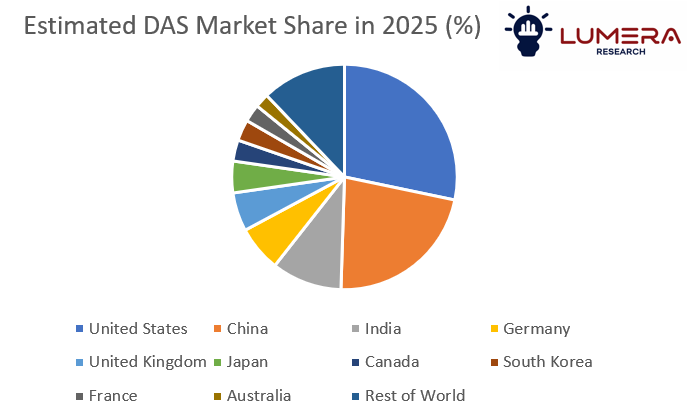
- North America – Largest regional market due to advanced wireless infrastructure, early 5G adoption, and high enterprise investment in indoor connectivity solutions.
- Europe – Steady growth supported by smart city initiatives, public safety communications needs, and widespread DAS deployment in commercial and transportation sectors.
- Asia Pacific – Fastest-growing region driven by rapid 5G rollouts, increasing smartphone penetration, and expanding urban infrastructure across China, India, Japan, and Southeast Asian economies.
- Latin America – Moderate growth attributed to infrastructure upgrades and increasing telecom investments.
- Middle East & Africa – Emerging opportunities as governments and enterprises invest in digital infrastructure and connectivity solutions for smart cities and industrial deployments.
Quick Market Figures:
• 2026 Market Size: ~USD 10.5–11.2 Billion
• 2036 Market Size (Projected): ~USD 18.3–19.5 Billion
• CAGR (2026–2036): ~5.8–6.3%
• Leading Segment: Pico & Small Cell DAS
• Fastest-Growing Regions: Asia Pacific & North America
Key Companies (Representative List):
- CommScope
- Ericsson
- Huawei Technologies
- Nokia
- Fujitsu
- SOLiD
- Zinwave
- Corning Incorporated
- Telect
- JMA Wireless
- Anixter International
- AT&T DAS Solutions
- Boingo Wireless
- Comba Telecom
- Kathrein Antennentechnik