The global Consumer Electronics Market is expected to demonstrate steady expansion over the forecast period from 2026 to 2036, driven by continuous product innovation, rising disposable incomes, increasing digital lifestyles, and rapid adoption of connected and smart devices. Consumer electronics encompass a wide range of products including smartphones, televisions, audio devices, wearable electronics, home appliances, and personal computing devices designed for everyday consumer use.
Technological advancements such as artificial intelligence, Internet of Things (IoT), 5G connectivity, and energy-efficient designs are reshaping consumer preferences and accelerating replacement cycles. Additionally, growing penetration of e-commerce platforms and direct-to-consumer sales models is enhancing product accessibility and global market reach.
Leading Segment:
By Product Type – Smartphones
Smartphones represent the leading segment in the global consumer electronics market, This segment dominates due to high global penetration, frequent upgrade cycles, and continuous innovation in features such as camera technology, AI integration, display quality, and processing capabilities.
Smartphones serve as central hubs for digital services, entertainment, payments, and communication, making them indispensable across age groups and income segments. Strong demand in emerging markets combined with premium device upgrades in mature economies continues to reinforce the leadership of this segment over other consumer electronics categories.
Market Drivers:
- Rising consumer demand for smart and connected devices.
- Continuous innovation in AI, IoT, and 5G-enabled electronics.
- Increasing disposable incomes and urbanization in emerging markets.
- Growth of e-commerce and omnichannel retail platforms.
- Expansion of smart home and wearable ecosystems.
Market Restraints:
- Price sensitivity in developing economies.
- Short product life cycles and high inventory risks.
- Supply chain disruptions and component shortages.
- Environmental concerns related to electronic waste.
Opportunities:
- Growing adoption of smart home devices and home automation systems.
- Expansion of wearable electronics for health and fitness monitoring.
- Demand for energy-efficient and sustainable electronics.
- Integration of AI-driven personalization and user experience enhancements.
Regional Insights:
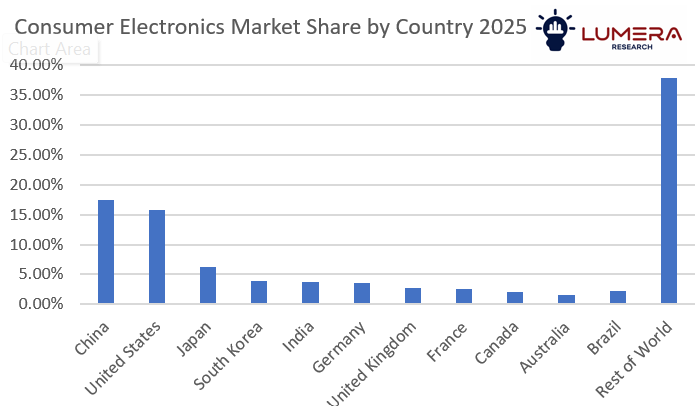
- Asia Pacific – Largest market driven by strong manufacturing base, high consumer demand, rapid urbanization, and growing middle-class population, particularly in China, India, Japan, and South Korea.
- North America – Steady growth supported by premium device adoption, strong brand presence, and high penetration of smart home and wearable technologies.
- Europe – Moderate growth driven by demand for energy-efficient electronics, regulatory focus on sustainability, and replacement demand.
- Latin America – Emerging growth region supported by improving retail infrastructure and increasing smartphone penetration.
- Middle East & Africa – Gradual growth driven by rising digital adoption, expanding retail channels, and increasing affordability of consumer electronics.
Market Size & Growth Outlook:
- Market Size (2026): ~USD 1,120–1,180 Billion
- Market Size (2036): ~USD 1,900–2,050 Billion
- CAGR (2026–2036): ~5.4–6.1%
Market growth is supported by strong demand for smart devices, premium electronics, and increasing adoption of connected home ecosystems across both developed and emerging economies.
Key Companies (Representative List):
- Samsung Electronics
- Apple Inc.
- Sony Corporation
- LG Electronics
- Panasonic Corporation
- Xiaomi Corporation
- Huawei Technologies
- Dell Technologies
- HP Inc.
- Lenovo Group
- Microsoft Corporation
- Canon Inc.
- Bosch
- Philips
- TCL Technology
Research Methodology:
This study on the Consumer Electronics Market employs a robust, multi-stage research methodology designed to ensure high data accuracy, reliability, and strategic relevance.
Data Collection – The research integrates extensive secondary research and primary validation. Secondary research includes analysis of company annual reports, investor presentations, regulatory publications, industry white papers, trade data, and technology journals to establish baseline market understanding and historical trends. Primary research involves in-depth interviews with industry stakeholders such as manufacturers, component suppliers, distributors, technology experts, and industry consultants. These interactions help validate assumptions, identify emerging trends, and refine market estimates.
Market Estimation & Forecasting – Market sizing is conducted using both top-down and bottom-up approaches. Revenue data from key companies is analysed alongside regional consumption patterns and shipment volumes to estimate current market size. Forecasts are developed using time-series analysis, demand modelling, and macroeconomic indicators, with adjustments for technology adoption rates and pricing trends.
Data Triangulation – All findings are cross-verified through data triangulation, combining insights from multiple data sources, analytical models, and expert opinions. This process minimizes bias and enhances the credibility of market estimates.
Quality Control – Assumptions and projections undergo multiple validation checks to ensure consistency and accuracy. Sensitivity analysis is applied to account for potential market uncertainties and scenario-based variations. This structured and transparent methodology ensures the research delivers actionable, decision-grade insights for stakeholders across the consumer electronics ecosystem.